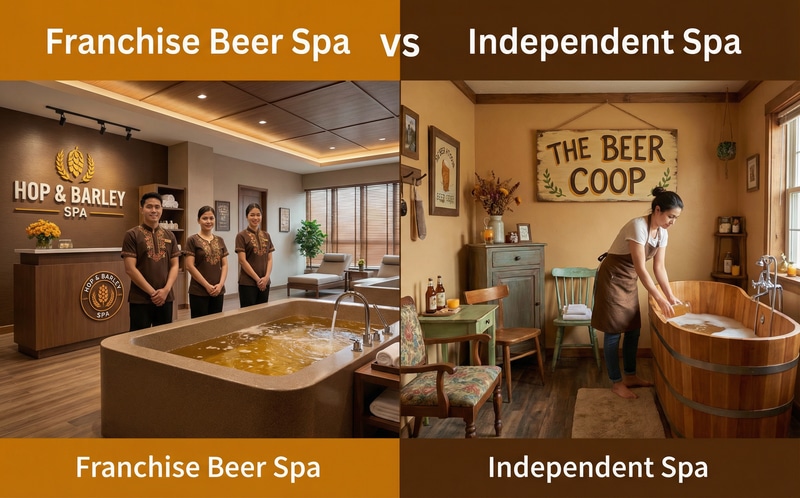
Deciding to start a business in the wellness industry is just the beginning. The key question follows: build your own brand from scratch, or bet on a proven franchise model? Both paths have their advantages and challenges. In this article, we compare both approaches from the perspective of investment, risks, support and returns – so you can make a decision based on facts, not assumptions.
Introduction: Franchise vs. Own Brand
A franchise is a business model in which a franchisor (brand owner) grants a franchisee the right to operate a business under their brand. The franchisee receives a ready-made concept, know-how, training and ongoing support in exchange for an entry fee and regular licence fees (royalties).
An own brand means building a business from the ground up – from the name and visual identity to business processes and marketing. The entrepreneur has full control over the direction of the company, but bears all risks and costs alone.
According to the International Franchise Association, franchising accounts for approximately 3% of GDP in developed economies and has been growing faster than most traditional business models over the past decade. In the wellness sector, this trend is even more pronounced due to rising demand for health and relaxation services.
Investment Comparison
Financial requirements are often the first criterion entrepreneurs consider. Let's look at typical costs of both models in the context of wellness business:
Franchise Model
- Franchise fee: approximately €50,000 (one-time entry fee for licence, training and access to the concept)
- Investment in equipment and premises: approx. €200,000 (equipment, construction modifications, working capital)
- Total: from €250,000
For this amount, you get a complete package – a proven business model, an established brand, supply chains and marketing support. The investment is transparent and predictable because the franchisor has experience from dozens of openings.
Own Brand
- Equipment and technology: €150,000–250,000
- Construction modifications: €50,000–100,000
- Branding and marketing: €30,000–50,000
- Working capital: €50,000–100,000 (first 6–12 months)
- Total: €300,000–500,000
An own brand is typically more expensive because you bear all the costs of concept development, testing and brand awareness yourself. Moreover, without experience from previous openings, there's a risk of unplanned expenses – from choosing the wrong supplier to oversized premises.
Risks and Certainties
Every business carries risks. The difference between a franchise and an own brand lies in how much of the risk you bear yourself and how much is mitigated by the system.
Own Brand – Higher Risk, More Freedom
- Unproven concept – you don't know if your model will work until you test it on the market
- Missing data – you have no benchmarks from other locations for comparison
- Reliance on your own know-how – you learn everything as you go; mistakes cost time and money
- Marketing from scratch – building brand awareness takes years
According to the European Franchise Federation, approximately 85% of franchise operations survive the first three years, while for independent businesses it's only about 50%. This difference is due to systematic support and a proven model.
Franchise – Lower Risk, Proven Model
- Proven concept – the model has been tested across dozens of locations
- Shared data – access to the financial results of the entire network
- Systematic support – from opening to daily operations
- Brand power – clients find you thanks to brand awareness
"Franchising isn't just buying a licence – it's a partnership where the success of one strengthens the entire network." – European Franchise Federation
What You Get with a Franchise
One of the biggest differences between the two models is the extent of support the franchisee receives. A typical franchise package in the wellness sector includes:
- Established brand – immediate access to a recognisable brand with an existing customer base
- Intensive training – typically 2 weeks of practical and theoretical training for operators and staff
- Location assistance – site analysis, demographic data, recommendations based on experience from other branches
- Equipment supply – verified suppliers at negotiated wholesale terms
- CRM and booking system – technology infrastructure ready for immediate deployment
- Marketing support – central campaigns, templates, social media management, SEO strategy
- 24/7 support hotline – round-the-clock assistance for operational issues and crisis situations
When running your own business, you need to build each of these areas yourself – from finding suppliers to setting up IT systems to creating a marketing strategy. This requires not only financial resources, but above all time and expertise in many different fields.
Business Freedom
An important factor in decision-making is the degree of control you want over your business.
Own Brand = Full Freedom
With your own brand, you have absolute freedom – from interior design to pricing policy to choice of suppliers and marketing strategy. You can change direction at any time, add new services or adjust the concept based on client feedback. This flexibility is especially valuable for experienced entrepreneurs with a clear vision.
Franchise = Standards with the Advantage of Network Effect
As a franchisee, you commit to maintaining brand standards – from quality of services to visual identity to operational procedures. This may seem limiting, but it brings a fundamental advantage: the network effect. Every new branch strengthens the entire network. When a location opens in Vienna and receives positive reviews, the Prague branch benefits too.
In most franchise models, you still have room for local customisation – you can choose supplementary services, collaborate with local partners and adapt marketing activities to the regional market.
Return on Investment
Return on investment (ROI) is probably the most important metric for every entrepreneur. Here, the two models differ significantly:
Franchise: 18–24 Months
Thanks to a proven model, an existing customer base and systematic marketing, franchise operations reach break-even significantly faster. Internal data from Lázně Pramen show an average ROI of 18–24 months from opening, with locations in tourist areas achieving returns even faster.
- Average monthly revenue: from €40,000 (after stabilisation in month 6)
- Operating margin: 35–50%
- Break-even point: typically month 4–6 of operation
Own Brand: 3–5 Years
Independent wellness businesses need significantly longer to achieve returns. The first year is usually dedicated to building brand awareness and fine-tuning operations. A stable clientele develops gradually, without the support of an established network.
- Average monthly revenue: variable, depends on location and marketing
- Operating margin: 20–40% (lower due to higher marketing and operational costs)
- Break-even point: typically month 12–18 of operation
Who Is a Franchise For?
The franchise model isn't for everyone – but for a certain type of entrepreneur, it represents an ideal path. A franchise is especially worthwhile if:
- You want to reduce risk – you don't have experience with wellness operations and want to rely on a proven system
- You're looking for a faster start – you don't want to spend years testing a concept and building a brand
- You value support – you want a team of experts available to help with every aspect of the business
- You prefer structure – you appreciate clearly defined processes and standards
- You have capital but not know-how – you have investment resources but lack specific industry knowledge
Conversely, an own brand may be a better choice for experienced entrepreneurs with deep knowledge of the wellness market, a clear vision and enough time and money to build a concept from scratch.
Conclusion
Both business models have their merits. An own brand offers maximum freedom and creative control, but at the cost of higher risk, longer payback and the need to build everything from the ground up. A franchise, on the other hand, provides a proven system, a strong brand and a faster path to profitability – with the condition of maintaining network standards.
For most beginning entrepreneurs in the wellness sector, a franchise represents a better risk-to-reward ratio. If you're interested in the Lázně Pramen franchise model, check out our Franchising page, where you'll find complete information about terms, investment and support.
Have questions or want to learn more? Contact us – we'll be happy to discuss your options and help you find the optimal path to your own wellness business.
Sources
- International Franchise Association – franchise.org
- European Franchise Federation – eff-franchise.com
- Internal data of Lázně Pramen s.r.o. (2024–2025) – network financial indicators