Natural vs chemical: what it means for guests and the bottom line
A conventional urban SPA stocks dozens of cosmetic products: oils, scrubs, essences, fragrances. These are consumables with short shelf lives, complex logistics and constant supplier rebranding. For the operator - a headache. For the planet - tonnes of plastic packaging.
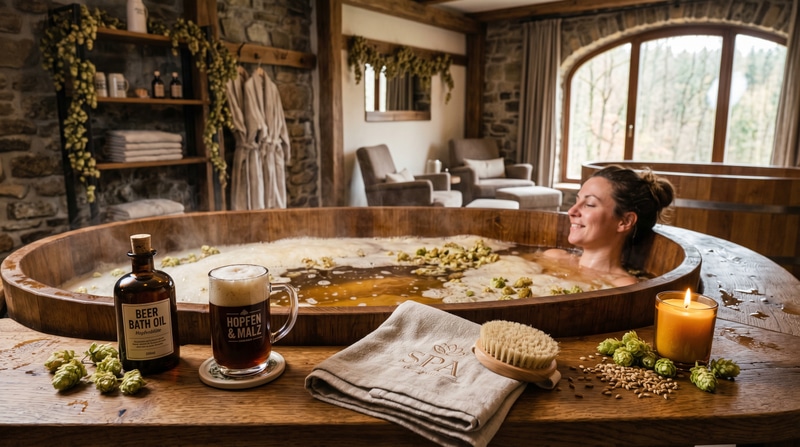
At a Lázně Pramen beer SPA the situation is fundamentally different. The tub formula consists of four natural ingredients: Žatec hops, malt, brewer's yeast and Czech Bernard beer. All of these are food-grade products with no synthetic additives. They are delivered in bulk packaging, can be stored for months and require no special disposal.
A study published in the Journal of Clinical Medicine confirms that balneotherapy with natural ingredients at 35-40 °C produces therapeutic effects comparable to chemical-based treatments - with zero ecological footprint from consumables.
For an investor, this means predictable ingredient costs, no dependence on cosmetic brands and a powerful marketing advantage - "natural" now sells better than any slogan.
Oak tubs vs acrylic baths: the economics of materials
Lázně Pramen tubs are handcrafted from oak and larch - durable hardwoods that last 15-20 years with proper care. By comparison, an acrylic bath in a conventional SPA loses its appearance after 5-7 years and then goes to landfill (acrylic is virtually non-recyclable).
A wooden tub is not just about ecology - it delivers a premium perception. The guest pays €50+ per treatment not in a plastic bath but in a 1 000-litre handcrafted oak barrel. According to the Global Wellness Institute, clients are willing to pay 20-30 % more for an eco-premium format.
In the Lázně Pramen franchise financial model, equipment (including tubs) is part of the starting investment from €200 000. Depreciation of wooden tubs - 15+ years. Acrylic - 5-7. That is a direct saving on equipment replacement and a competitive edge in marketing.
Local suppliers: short chain = low carbon footprint
Hops come from Žatec (100 km from Prague). Malt - from Czech breweries. Bernard beer - from a family brewery in Humpolec. Yeast - a by-product of brewing. The entire supply chain stays within a single country; the distance from supplier to branch is under 200 km.
For comparison: a conventional SPA sources cosmetics from L'Occitane (France), Elemis (UK), Comfort Zone (Italy). Logistics through 3-4 countries, cold chain, customs. The carbon footprint of a single delivery is tens of times higher.
A report by the European Parliament on the circular economy stresses that shortening supply chains is one of the key factors in reducing the environmental impact of business. The Lázně Pramen franchise operates on this model by default.
As the network scales to new cities (target - 10+ locations by 2027, including Berlin, Vienna, Munich, Krakow and Budapest), the model adapts: Bavarian hops in Germany, Silesian malt in Poland. Local adaptation preserves a short supply chain in any country.
Water and energy: what happens to the tub after a guest
Each tub is refilled before every guest - that is a hygiene standard. But unlike conventional SPAs with chlorinated pools and recirculation, the water from a beer tub is a biodegradable solution. Hops, malt, yeast - all organic matter that does not pollute the sewer system.
A 1 000-litre tub at 35-38 °C. Heating - electric. Jacuzzi - automatic. No need for gas boilers, chemical treatment plants or chlorination systems. According to the International Energy Agency, electric water heating combined with insulation (and wood is a natural insulator) is one of the most energy-efficient methods available.
For the franchise operator this means: no costs for maintaining chlorine systems, no fines for chemical discharge, no need for environmental pool licences. Operating expenses - 45 % of revenue, including utilities.
Eco-friendliness as a marketing asset
The eco-wellness trend is not a fad - it is a lasting shift in consumer behaviour. According to the Global Wellness Economy Monitor 2024, the global wellness market has reached $5.6 trillion, with the sustainable wellness segment growing faster than the overall market - at 12 %+ per year.
Lázně Pramen does not need to "pretend" to be eco-friendly. A beer SPA is ecological by nature: natural ingredients, wooden tubs, biodegradable waste, local suppliers. This is not greenwashing - it is the business model.
The result for franchisees: 85 % repeat clients, a 4.8/5 rating on Tripadvisor, 50 000+ guests per year across the network. Clients return not because it is "eco-friendly" but because it works. Yet eco-friendliness is a powerful argument at the first visit.
Numbers for investors: sustainability that generates profit
Starting investment: from €200 000 (including franchise fee €50 000, equipment, fit-out, training, initial marketing).
Payback: 18-24 months from opening.
EBITDA: 30 %+ (data from operating locations).
Operating margin: 40-60 % (internal data 2024-2025).
Average check: €50+ / 1 500 CZK+.
Client flow: 600+ visitors per month per location.
Royalty: 6 % of turnover + 2 % marketing fund. First 3 months - royalty-free.
Sustainability reduces operating costs (no expensive cosmetics, no chlorine systems, long-lasting equipment) and boosts the average check (eco-premium positioning). This is not a "green" surcharge on cost - it is a competitive advantage built into the business model.
Want to run the numbers yourself? Use the profitability calculator on the franchise page. Questions? Get in touch - we respond within one business day.
Sources
- Matz H. et al. - Balneotherapy in dermatology (Dermatologic Therapy, 2003)
- Global Wellness Institute - Global Wellness Economy Monitor 2024
- Global Wellness Institute - Industry Research: Eco-Premium Pricing
- European Parliament - Circular Economy: Definition, Importance and Benefits
- International Energy Agency - The Future of Heat Pumps (2022)
- Lázně Pramen - Franchise: terms and calculator