What the global wellness economy actually covers
The term wellness economy covers far more ground than most people assume. This is not simply gyms and dietary supplements. The sector stretches across spa treatments, health tourism, beauty and personal care, preventive medicine, healthy eating, wellness real estate and the wider business of mental wellbeing. That breadth is precisely what makes it one of the most dynamic areas of the global economy. According to the Global Wellness Institute, the sector reached a new record of 6.8 trillion dollars in 2024, having doubled in size since 2013.
What makes this sector so compelling for investors and operators is its resilience and its steady upward trajectory. Where many traditional industries move in cycles, demand for health, recovery and personal wellbeing stays stable and keeps climbing. People are increasingly willing to spend both time and money on their physical and mental condition. This shift in values is not confined to a single generation or a single region. It is a worldwide phenomenon that is reshaping consumer behaviour across markets.
Within that picture, experiential spas occupy an unusually attractive niche. They combine relaxation, culture and a distinctive experience that is genuinely hard to substitute. Lázně Pramen, which has run beer and wine spas in Prague since 2007, is a working example of how a sweeping global trend can be turned into a concrete, functioning business model. The wellness economy is not an abstract macroeconomic figure. It is a real market built from thousands of specific services that people actively seek out. Understanding its structure and momentum is the first step toward spotting an opportunity where others overlook it. In the sections that follow, we look at the numbers, the trends and the mechanics that make wellness one of the most promising directions for capital today.
The numbers that are changing how the health sector is viewed
The hard data tells an unambiguous story. Between 2023 and 2024 the global wellness economy grew by 7.9 percent to reach 6.8 trillion dollars, a pace that comfortably outstrips the growth of the world economy as a whole. Analysis suggests the sector has expanded by roughly 35 percent since 2019, an annual growth rate of around 6.2 percent. Forecasts point to further acceleration, projecting that wellness could reach 9.8 trillion dollars by 2029.
These figures carry real weight. They show that health and personal wellbeing have stopped being a luxury and become a permanent fixture of how broad swathes of consumers live. Rising wellness spending is not the residue of a passing fad but the result of a structural change in how people allocate their time and their money. Prevention, recovery and quality of life have moved to the foreground, creating demand that is both stable and expanding.
One segment stands out within the whole: health and wellness tourism. Estimates put the wellness tourism market close to one trillion dollars a year, with continued expansion expected over the coming decade. Prague, as a global tourist destination, naturally benefits from this trend, drawing visitors who come not only for history and culture but for memorable experiences built around rest and recovery.
This is exactly where the opening lies for operators and investors. A growing market creates demand for new venues, services and concepts. The model offered by a franchise network of experiential spas allows investors to take part in that momentum with clearly defined rules and an established brand behind them. Anyone searching today for an industry with genuine long-term potential will struggle to find a more convincing blend of growth, stability and emotional value than the wellness sector provides.
Wellness as part of national economic output
One of the most striking features of recent years is that wellness has stopped being a marginal line item and become a measurable component of national economic output. Set the size of the wellness economy against gross domestic product and the sector, were it a country in its own right, would rank among the largest economies in the world. That comparison captures just how central health and wellbeing have become to the global economy.
For the Czech Republic, and for Prague in particular, this shift has concrete consequences. Spa culture runs deep here, woven into the country's cultural identity over centuries. Where classic spas built their reputation on healing springs and medical indications, the modern wellness economy broadens that idea to include experiential and lifestyle elements. Beer and wine spas are exactly this kind of extension, blending traditional craft, gastronomic culture and a contemporary approach to relaxation.
The economic importance of wellness also shows up in employment, tax revenue and the growth of supporting services. Each new venue generates jobs and demand for local ingredients and related goods. Lázně Pramen works exclusively with quality raw materials such as Saaz hops, malt, yeast and the Czech craft beer Petrovické, supporting an entire chain of domestic suppliers in the process.
For investors, the lesson is important. Investing in wellness is not a bet on a single venue but participation in an industry firmly anchored in its economic and social setting. That grounding makes the business more resilient to swings and turns it into an attractive proposition for anyone seeking a sustainable, long-growth segment. Those weighing entry into the sector can find more detail through the section aimed at investors, which sets out specific ways to collaborate and take part in the network's development.
Why experiential spas stand out in a crowded wellness market
The wellness market is broad and varied, but not every segment offers the same degree of differentiation or margin. Experiential spas carry several traits that set them apart from ordinary wellness services and make them an unusually interesting investment category. The key is the uniqueness of the experience, something that cannot be easily copied or replicated at home.
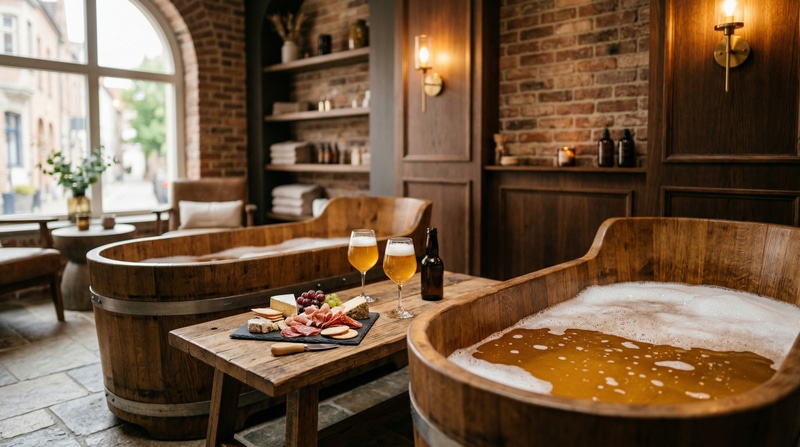
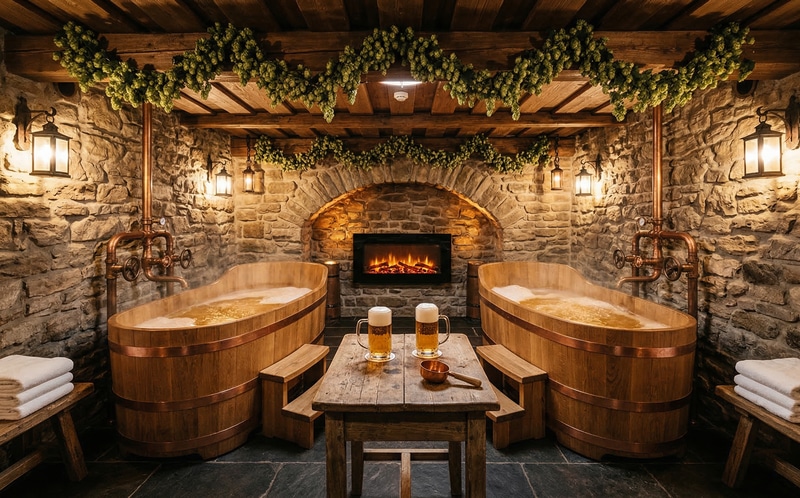
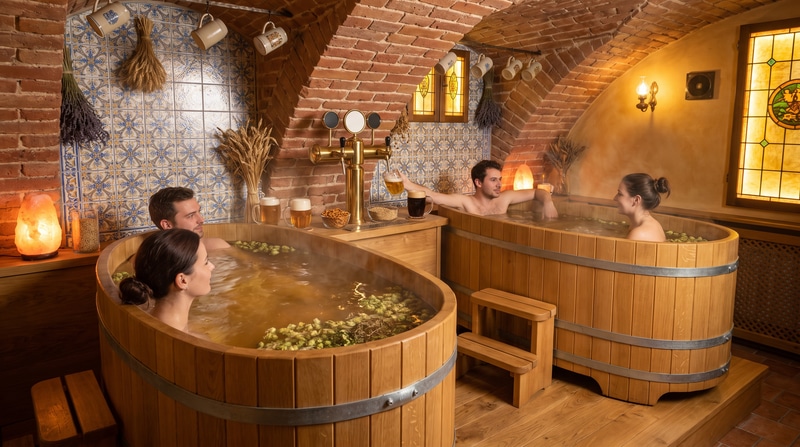
Beer spas are the perfect illustration. A soak in warm water enriched with Saaz hops, malt and yeast at 35 to 38 degrees Celsius is a sensory experience that ties the heritage of Czech brewing to genuine relaxation. Guests can even pour themselves a fresh craft beer from a tap during the bath. This kind of experience forges a strong emotional bond, one that guests carry with them and happily return to.
The flagship venue in Prague's Dejvice district offers four private rooms, each with its own character. Zlatý pramen holds two tubs for two to four guests; Rubínový pramen and Smaragdový pramen, which serves as a V.I.P. room, each have a single tub. Safírový pramen is a salt cave designed for massage. This variety makes it possible to serve very different needs, from intimate couples' wellness to larger group bookings, without ever changing location.
From an investment standpoint, experiential spas hold several decisive advantages. They deliver high added value, a strong tie to the brand and resilience against direct competition. The customer is not buying a service alone but a story and an atmosphere. Hand-crafted oak and larch tubs with a 1,000-litre capacity underline the authenticity of the whole concept. In a market where consumers increasingly prize originality and depth of experience, that authenticity becomes a decisive competitive edge that is extraordinarily difficult to imitate.
The franchise model as a route into the growth
One of the most practical ways to share in the growth of the wellness economy is to join an established franchise network. The franchise model lets an investor draw on a proven concept, a brand and a body of know-how without having to build everything from scratch. That significantly lowers the risk of entering a new industry and shortens the time needed to reach profitability.
The economics of an experiential spa franchise are transparent and publicly available. The entry franchise fee is 50,000 euros, the initial investment starts at 200,000 euros, and the full package runs from 250,000 euros upward. The ongoing royalty is 6 percent of turnover, with a further 2 percent going into the marketing fund. The first three months of operation are exempt from ongoing fees, giving a new partner room to find their feet.
Payback typically falls between 18 and 24 months, and roughly six months pass from signing the contract to opening the doors. The location requirement sets a minimum floor area of 150 square metres. Monthly operating costs run in the range of 15,000 to 25,000 euros. Financing is generally available for 60 to 70 percent of the total investment, which makes it easier to put together a realistic financial plan.
That transparency is a real advantage for anyone considering a serious investment. Instead of vague promises, a prospective partner receives concrete numbers to work with and to verify. Those who want to discuss the details and possible terms of collaboration can use the contact form to arrange a no-obligation consultation. The combination of a proven concept, clear economics and a growing market creates a favourable environment for commercial success in one of the most promising segments of the economy today.
Corporate wellness and its return on investment
A significant and fast-growing strand of the wellness economy is corporate care for employees. Companies increasingly recognise that the health and mental wellbeing of their staff is not merely a moral obligation but an economically rational investment. Programmes focused on employee health deliver a measurable return through lower absenteeism, higher productivity and a stronger ability to hold on to talented people.
The research in this area is encouraging. Analyses drawing on dozens of studies suggest that comprehensive employee health programmes achieve a distinctly positive return. According to McKinsey research, improving employee health and wellbeing could generate economic value running into the trillions of dollars worldwide. Some studies further expect that the average return on corporate wellness programmes will keep rising, with firms that invest more in their people's health achieving stronger results.
For experiential spas, this represents an appealing commercial opening. Corporate clients can use gift vouchers as an employee benefit or as a gesture for business partners. Group bookings in the private rooms are ideal for smaller company events, team-building sessions or informal gatherings that strengthen bonds within a workforce. The setting of an experiential spa offers something out of the ordinary that conventional corporate perks cannot match.
Lázně Pramen therefore offers not only individual experiences but also solutions for corporate clients looking for an original way to care for their staff and partners. This dual orientation, toward both individual and corporate customers, widens the potential market and adds to the stability of a venue's revenue. For the investor, diversifying the sources of demand is another factor that lowers risk and strengthens the long-term sustainability of a business in a segment of the wellness economy that keeps gaining in importance.
Regional differences and opportunities across Europe
The wellness economy is not spread evenly. Individual regions and countries differ markedly in the maturity of their markets, in consumer habits and in the cultural relationship people have with looking after their health. It is precisely these differences that create room to expand concepts proven in one setting into others where they can succeed. Europe is an especially interesting arena here, thanks to its purchasing power, its population density and its strong spa tradition.
Central Europe, and the Czech Republic in particular, holds a unique position in spa culture. The blend of historical tradition, brewing heritage and rising appetite for experiential tourism creates ideal conditions for experiential spas to grow. While the wellness market in some Western European countries is already very mature and highly competitive, other regions are only beginning to show their potential. That leaves room for targeted expansion of the franchise network in places where demand is growing faster than supply.
Forecasts anticipate that the wellness economy will keep growing sharply in the years ahead, with European markets playing a substantial role. Rising living standards, an ageing population and a growing emphasis on prevention are generating durable demand for services tied to health and rest. Experiential spas, which offer a distinctive and culturally rooted product, are well positioned in this environment.
For investors and operators weighing entry into one of Europe's markets, a proven concept with a clear identity is a decisive advantage. Rather than experimenting with an untested idea, they acquire a ready model that can be adapted to local conditions. Prospective partners will find details on investment and expansion in the section for investors. The ability to read regional differences and turn them to your advantage is one of the defining skills of a successful investor in a wellness economy that is growing at pace.
How to start investing in the wellness economy
Deciding to invest in the wellness economy is the first step, but reaching success takes a considered, structured approach. The key is to understand that this is not a passive financial instrument but participation in a specific business with real operational demands. That is why it pays to give careful thought to choosing the right segment, the right concept and the right partner to carry the plan through.
The first step should be a thorough grasp of the economics of the chosen opportunity. In the case of an experiential spa franchise network, those numbers are publicly available and transparent, which makes realistic planning possible. An investor should weigh their capital position, their financing options and the horizon over which they expect a return. With payback in the range of 18 to 24 months and a build-out period of around six months, it is possible to draw up a fairly precise timeline.
The second consideration is choosing the right location. Wellness venues benefit from proximity to tourist hubs, business districts or densely populated areas with sufficient purchasing power. The minimum floor area of 150 square metres gives a sense of the kind of space to look for. The right location is one of the strongest determinants of future success.
The third step is making contact and gathering detailed information. We recommend studying the section for investors and then using the contact form to arrange a consultation where your particular situation and options can be discussed. For further inspiration and context, our blog regularly covers themes tied to wellness, spa culture and doing business in the sector. Entering a growing market with a proven concept is a rational way to pair a financial opportunity with a business that delivers genuine value and pleasure to people. The wellness economy will keep growing in the years to come, and those who enter now with a well-thought-out strategy stand to profit from that wave over the long run.
Sources
- Global Wellness Institute - The Global Wellness Economy - globalwellnessinstitute.org
- Global Wellness Institute - Wellness Economy Statistics & Facts - globalwellnessinstitute.org
- The Wellness Economy: Definition, Size, and What's Next (EHL Insights) - insights.ehl.edu
- Wellness Tourism Market Size & Share 2026-2035 (GM Insights) - www.gminsights.com
- ROI on Wellness Programs: How to Measure & Communicate Value - selerix.com
- Return on Investment of Workplace Wellness (PubMed) - pubmed.ncbi.nlm.nih.gov