
Introduction: Two Paths to Scaling a Wellness Brand
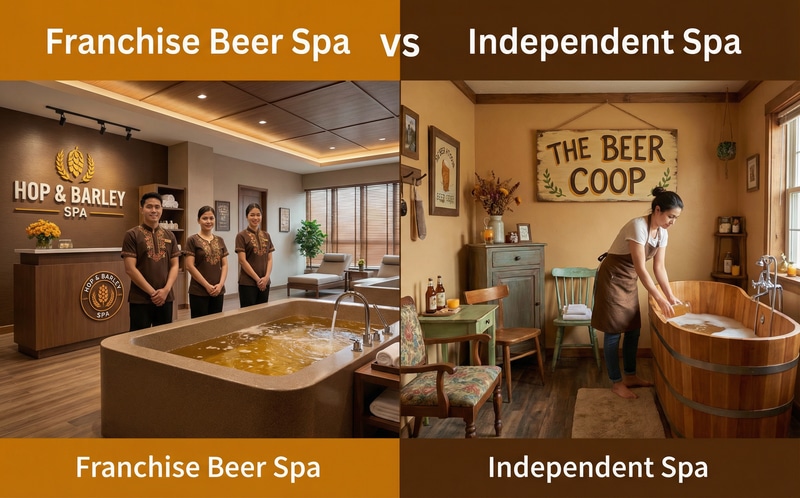
If you're planning to enter the growing wellness and spa tourism market, you face a fundamental strategic decision: how to structure the business. The two dominant options - franchise and license model - look similar at first glance, but in reality they differ on every meaningful parameter: entry costs, degree of control, royalties, scope of support, and legal liability.
According to data from the International Franchise Association (IFA), in 2026 the franchise sector in Europe generates over EUR 170 billion in turnover, with wellness and personal services among the fastest-growing segments (+7.8% year-on-year). The license model, by contrast, still dominates primarily in the technology and fashion industries - according to Licensing International, the global licensing market reached a retail value of approximately USD 356 billion in 2024.
This article compares both models with a focus on the wellness sector and shows exactly how the Lázně Pramen franchise works in practice - a €50,000 upfront fee, total investment from €200,000, and typical payback of 18-24 months.
What Is a Franchise
A franchise is a long-term contractual partnership in which the franchisor (grantor) transfers to the franchisee (recipient) a complete business system: brand, trademark, operating manuals, know-how, supply chains, training, marketing, and technical support. The franchisee operates their own business under the franchisor's brand and pays an upfront fee plus ongoing royalties on turnover.
In the wellness sector, the franchise is the dominant expansion model. Real-world examples: Massage Envy (USA, over 1,100 locations), Hand & Stone Massage (USA/Canada, roughly 600 units), European Wax Center (over 1,000 centers), and in Europe Beauté Pacifique or the Scandinavian chain Nordic Wellness. The common denominator is a standardized customer experience that transfers trust from one location to the entire network.
The relationship is regulated: in the EU it follows the European Code of Ethics for Franchising, and in the USA the FTC Franchise Rule. The franchisor is required to provide pre-contractual disclosure (FDD or information memorandum) with detailed financial data on the network.
What Is a License
A license is a narrowly defined permission to use a specific right - typically a trademark, patent, technology, design, or copyrighted content. The licensee gains the right to use a product or brand in their own business, but does not receive a complete business system. The operating model, processes, quality standards, and marketing are all the licensee's own responsibility.
The legal framework is built mainly on contract law and intellectual property conventions administered by WIPO. Unlike a franchise, the licensor has no obligation to provide ongoing training, marketing, or quality control - commitments are limited to whatever the parties put in writing.
In wellness, pure licensing appears only on the margins - for example, with beer-based cosmetic products sold under another brand, with recipes, or with furniture and equipment. For running a brick-and-mortar SPA, licensing is rarely used, because the customer expects a consistent experience that only a strong centrally managed system (i.e. a franchise) can guarantee.
Comparison Table: Franchise vs License
A quick overview of the key differences. The figures are representative for the European wellness sector in 2026:
| Parameter | Franchise | License |
|---|---|---|
| Upfront fee | €30,000 - €150,000 | €0 - €30,000 (flat fee) |
| Ongoing royalties | 4-8% of turnover | 2-5% or a one-off payment |
| Quality control | High - mandatory standards, audits | Low - limited to the trademark |
| Training and know-how | Yes - 3-6 weeks + ongoing support | No, only as per contract |
| Marketing | Shared fund of 1-3% of turnover | Licensee's own responsibility |
| Contract length | 5-10 years with renewal option | 1-5 years |
| Territorial exclusivity | Usually yes | Optional |
| Operational freedom | Limited (manuals) | High |
| Typical 5-year survival rate | 80-90% (IFA) | Hard to measure, lower |
Advantages of the Franchise Model
A franchise minimizes the main risk of any start-up - an unknown brand and untested processes. The franchisee begins with a product that has already proven demand and has validated unit economics. According to Franchise Business Review, over 80% of franchise units reach the five-year mark, while independent small businesses manage roughly 50%.
Another key advantage is the completeness of the offering: operating manuals cover dozens of areas (HR, hygiene, booking system, inventory management, crisis management) that the franchisee would otherwise have to solve from scratch. Franchisor support continues throughout the contract term - sharing best practices between locations, central development of new products, and group negotiation with suppliers.
For investors, a franchise is also attractive because of predictable cash flow. Thanks to standardized KPIs, control mechanisms, and group marketing, risk is significantly lower than with an independent launch - and banks view this favorably when financing.
- Proven brand and instant customer trust
- Complete operating system and training
- Central marketing and bargaining power
- Higher survival rate and faster return on investment
- Easier access to bank financing
Advantages of the License Model
A license is attractive when you already have your own functioning business and want to expand the portfolio with a specific iconic element - for example, selling beer cosmetics under a well-known brand, licensing a patent for tub technology, or using furniture designs. Entry costs are an order of magnitude lower than with a franchise, and operational freedom is maximized.
A license is a fast route to international expansion for strong brands - the licensor can rapidly establish a presence in dozens of markets without investing in their own units. At the same time, the licensee benefits from the brand's recognition without having to adopt the entire operating model.
Financial commitments are more flexible. Typically you pay either a one-off flat fee or lower ongoing royalties (2-5%). Licensing also does not require pre-contractual disclosure (FDD) and the contract documentation is usually shorter.
- Low entry barrier
- Maximum operational freedom
- Fast international scalability for the licensor
- Simpler legal framework (no FDD)
- Ability to combine multiple licenses
Risks and Drawbacks of Both Models
Franchise risks lie primarily in higher entry costs and lower flexibility. The franchisee is bound by manuals, brand standards, and an approved product range - personal creativity is only possible within corporate rules. A long-term contract (5-10 years) with mandatory royalties represents a fixed financial commitment even in years when business is slow. In the event of conflict, termination is often difficult.
License risks are the opposite: without an operating system, the licensee is on their own. If they lack sufficient experience in the wellness sector, they often miss processes, quality standards, and effective marketing. This leads to an inconsistent customer experience and damage to the reputation of the licensed brand - which tends to be the main reason the licensor terminates the agreement early.
Intellectual property protection is also harder. In an international setting, the licensor has limited tools to enforce standards, and a dispute over trademark misuse is costly and lengthy. That's why modern licensors are increasingly shifting to hybrid models with franchise elements - mandatory audits, minimum service standards, reporting.
Financial Comparison: What You Will Actually Pay
Model case: opening a beer spa with 3 bathing tubs on 130-150 m² in a European city of over 200,000 inhabitants.
Franchise scenario (Lázně Pramen example): upfront fee €50,000, investment in renovation and equipment from €200,000, total budget €250,000 to €350,000 depending on location. Operating fixed costs €15,000-25,000/month. Royalty 6% of turnover + 2% marketing fund - first 3 months royalty-free. Payback of 18-24 months, EBITDA margin typically 30%+ in the third year.
License scenario (hypothetical): license fee of €10,000-30,000 for use of the brand and recipes, with no operational support. Investment in renovation and equipment is the same (€200,000), but everything is the licensee's responsibility - interior design, suppliers, tub technology, booking system, staff training, marketing. Without existing sector expertise, launch takes 6-12 months longer, and the risk of mistakes grows. Payback is hard to predict - according to the Global Wellness Institute, wellness projects launched independently more often end up loss-making in the first two years.
The conclusion of the financial comparison is clear: with a license you save on entry, but you pay in time, mistakes, and risk. A franchise has a higher price tag, but a clearly mapped path to profit. For investors seeking a controlled return, a franchise is typically the more rational choice.
The Lázně Pramen Franchise Model: Concrete Numbers
Lázně Pramen has operated beer and wine spas in Prague since 2003 and develops its franchise network as the only original Czech brand in this segment. The model is structured as a full franchise with territorial exclusivity:
- Upfront fee: €50,000 per unit
- Total investment: from €200,000 (renovation, 3 oak bathing tubs, equipment, training, first marketing campaign)
- Royalty: 6% of monthly turnover (first 3 months royalty-free)
- Marketing fund: 2% of turnover
- Contract term: 10 years with a renewal option
- Territorial exclusivity: yes, a city or defined catchment area
- Training: 4 weeks at the central Prague location + ongoing on-site support at opening
- Expected EBITDA: 30% and above from year 3
- Average payback: 18-24 months
The package includes a proprietary booking system, supplier contracts for ingredients (hops, malt, live beer, herbs), a complete brand manual, an interior design pack, and access to 22 years of operational know-how. We prepare a more detailed financial model individually - we send it on request via the contact form.
Conclusion: Which Model Is Right for You
Choose a franchise if you do not have deep experience running a beer spa, want to eliminate risk, and need a clearly mapped path to profit. You gain a proven brand, a complete system, and the support of an experienced team. The higher entry costs are offset by faster payback and lower failure rates.
Choose a license if you already have your own functioning wellness business or a strong team and only need a specific element - a brand for a one-off product, a patent, a technology. Or if you are an investor with no interest in operational details who is looking for purely capital participation in another form.
If you are seriously considering opening a beer SPA, the Lázně Pramen franchise offers clear economic logic in 2026: lower risk, faster launch, controlled EBITDA above 30%, and payback under two years. Get in touch - we'll send you a detailed financial model and documentation for bank financing.
Sources
- International Franchise Association - franchise.org
- European Franchise Federation - eff-franchise.com
- FTC Franchise Rule Compliance Guide - ftc.gov
- WIPO - International Licensing - wipo.int
- Licensing International - licensinginternational.org
- Franchise Business Review - franchisebusinessreview.com
- Global Wellness Institute - globalwellnessinstitute.org