Water that heals: why Czech spas became a global reference point
Say the word spa to most Europeans and their minds drift, sooner or later, to Bohemia. That is no accident. Across a relatively small territory sits an unusual density of mineral and thermal springs that people have used for centuries - first by instinct, later by design, with the backing of medical science. Czech spa culture is neither a tourist gimmick nor an empty marketing label. It is a craft, a culture, and a way of thinking about health that has passed from one generation to the next for more than five hundred years.
The roots run deep into the Middle Ages, when the first accounts of the healing power of hot waters began to circulate. Over time, a simple soak beside a spring became a deliberate therapeutic regimen, and around it grew whole towns - architecture, music, gastronomy and a rich social life. A spa town was never merely a place to mend the body. It was a place of encounter, diplomacy, art and rest for the mind.
This unbroken tradition is precisely what informs the modern wellness concept developed by Lázně Pramen. Instead of hot mineral springs, we offer immersion in beer and wine baths, but the underlying idea is unchanged: a natural raw material, warm water, quiet, and care for the whole person. In this article we trace Czech spa culture from its earliest beginnings, through the golden age of the nineteenth century, to the form you will find today in our Dejvice location in Prague. You will see that tradition and innovation are not at odds. On the contrary, each feeds the other, and together they create an experience with deep roots that still speaks the language of the present.
From legend to medical discipline: the earliest beginnings
Like most ancient places, the history of Czech spas rests on a blend of fact and folklore. The best-known legend has Emperor Charles IV discovering the hot springs of Karlovy Vary while hunting in the fourteenth century. Whether the story is literal or symbolic, one thing is certain: Karlovy Vary received its town privileges in 1370, and its name still carries the memory of its imperial patron.
Early use of the springs was simple and empirical. People noticed that bathing in warm mineral water eased aching joints, soothed skin complaints and lifted fatigue. Observation gradually gave way to systematic study. A decisive turning point came in the late fifteenth and sixteenth centuries, when the first medical treatises devoted to Karlovy Vary water appeared. In 1522 the physician Vaclav Payer published a study now regarded as one of the earliest professional texts on the therapeutic use of the local springs.
This early phase also crystallised a principle that would run through the entire history of Czech spa culture: the conviction that nature offers the means to heal, and that those means need only be properly understood and applied. Water, heat, quiet and time - these four elements formed the core of treatment even then, and in one form or another they still sit at the heart of every serious spa procedure today.
Tellingly, spas were never seen as purely medical facilities. Nobles and townsfolk alike arrived to combine treatment with rest and society. That dual character - therapeutic and recreational at once - remained a defining trait of Czech spa culture and shaped its later flowering. Without this social dimension, spas would never have become the cultural phenomenon they were destined to be in the centuries that followed.
The golden age: the nineteenth century and European spa culture
Czech spa culture reached its full height in the nineteenth and early twentieth centuries. Karlovy Vary, Marianske Lazne and Frantiskovy Lazne - the so-called spa triangle of western Bohemia - became one of the hubs of European social life. Aristocrats, artists, scientists and politicians arrived from across the continent. A spa stay was, in this era, treatment, holiday and social event of the highest order all in one.
Marianske Lazne, which was granted town status only in 1865, stood out for its exceptionally deliberate urban design. Colonnades, parks, springs and hotels formed a harmonious whole, laid out so that guests moved through the day between the various springs, walking amid greenery with music in the background. Here the spa town emerged as a work of art in its own right, where architecture served health and aesthetic pleasure at the same time.
The guest lists read like a survey of European history. Composers, writers and rulers came to Karlovy Vary and Marianske Lazne alike. Johann Wolfgang Goethe spent part of his life in Marianske Lazne and drew inspiration from its setting. Fryderyk Chopin, Richard Wagner, Franz Kafka and many others sought relief and inspiration here. This concentration of talent and power turned the Czech spa towns into crossroads where ideas, friendships and political decisions took shape.
The golden age left a legacy still visible today - in the grand colonnades, hotels and springs that were inscribed in 2021, alongside other European spa towns, on the UNESCO World Heritage List under the title The Great Spa Towns of Europe. That recognition confirmed what the industry had long understood: Czech spa culture is not a local curiosity but part of the shared cultural wealth of the whole continent.
The science behind the tradition: balneology as a medical field
Behind the romantic facade of colonnades and springs lies a serious medical discipline. Balneology - the study of the therapeutic use of mineral waters, gases and peloids - developed to a high standard in the Czech lands and became a respected branch of medicine. Czech spa culture was never merely a luxury experience; it always rested on an effort to understand why and how treatments work.
Mineral springs differ in chemical composition, temperature and gas content, and it is precisely these properties that determine their therapeutic use. The high-mineral thermal springs of Karlovy Vary were traditionally used for digestive complaints, while others found application in disorders of the musculoskeletal system, the respiratory tract or the skin. Spa treatment never rested on a single procedure - it combined drinking cures, baths, physical activity, diet and rest into a considered whole.
Modern research confirms that many traditional practices have a measurable physiological basis. A warm bath demonstrably improves circulation, releases muscular tension and helps to lower stress. Studies of thermal and balneological procedures document favourable effects on sleep quality, perceived pain and general wellbeing. What earlier generations observed empirically, controlled research now bears out.
This scientific dimension is exactly what links historic spa culture to today's wellness. When you sink into a warm beer bath infused with extracts of hops, malt and yeast, the same principles act on your body as in a traditional balneological procedure: heat, active compounds and deep relaxation. The difference lies in the raw material and the context, not in the underlying mechanism. Hops contain compounds long associated with calming effects, and warm water makes the skin more receptive to them. Tradition and science, in other words, walk hand in hand even in a modern setting.
The twentieth century and rebirth after 1989
The twentieth century brought dramatic reversals for Czech spa culture. Two world wars severed the international clientele on which the spa towns depended. After 1948 came a fundamental shift: the spas were nationalised and absorbed into the public health system. That change had two faces. On one hand, spa treatment became accessible to broad sections of the population as part of medical care. On the other, the old international social lustre vanished, and many historic buildings suffered from a lack of investment.
Under socialism the spas were profiled above all as therapeutic facilities for patients with specific diagnoses. A treatment stay on a doctor's recommendation was a routine part of healthcare, and the spas retained their professional standing. Yet much of what had made them attractive to foreign guests was missing - comfort, variety of services and a free atmosphere.
The decisive turn came after 1989. With the return of a market economy, the door opened to privatisation, investment and renewal. Historic buildings underwent demanding reconstructions, the international clientele returned, and Czech spas rejoined the ranks of sought-after destinations. At the same time a new trend began to form: alongside classic therapeutic spa care, a distinct segment of wellness and relaxation services emerged, aimed not at sick patients but at healthy people looking for recovery and prevention.
This shift opened the door to inventive concepts. It was in this climate of rediscovered spa culture and rising demand for experiential rest that the Lázně Pramen brand was founded in Prague in 2007. It built on a centuries-old tradition of caring for the body with a warm bath, but introduced its own original raw material and format. The aim was never to compete with the therapeutic spas of Karlovy Vary, but to grow a new branch on the same tree - spa culture as an experience available in the heart of the capital.
Beer and wine spas: a new chapter in an old tradition
Beer is as deeply rooted in Czech culture as the spa tradition itself. It is no surprise, then, that the two eventually met. The beer spa grew from a simple but ingenious idea: what if the ingredients used to brew Czech beer were turned to the care of the body? Hops, malt and yeast contain compounds that benefit the skin, and a warm bath amplifies their effect.
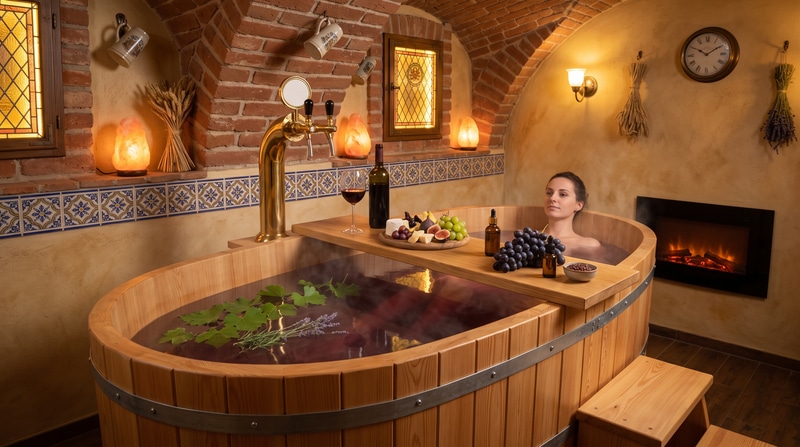
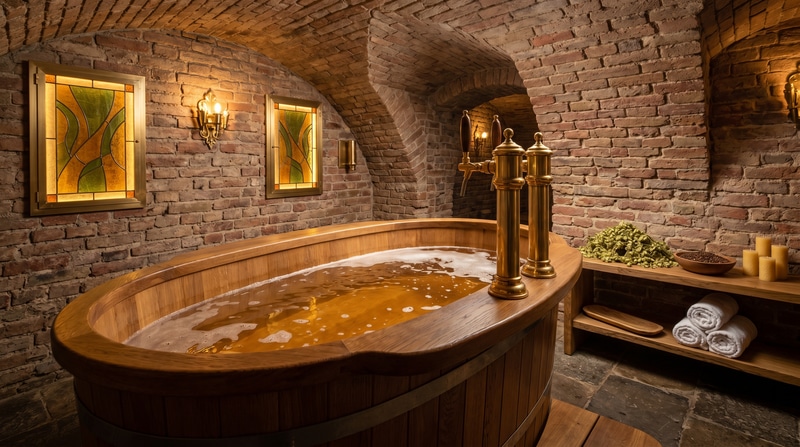
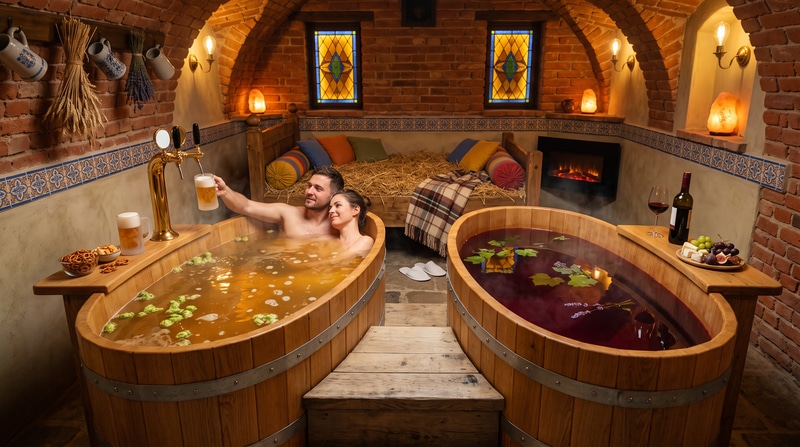
At the Dejvice location of Lázně Pramen, this idea unfolds in a setting that deliberately evokes a historic spa character. A cellar space with four private rooms - named Zlatý pramen, Rubínový pramen, Smaragdový pramen and Safírový pramen - creates an intimate atmosphere far from the noise of the city. Baths take place in hand-crafted 1,000-litre tubs of oak and larch, with water held between 35 and 38 degrees Celsius, the optimal range for relaxation and circulation.
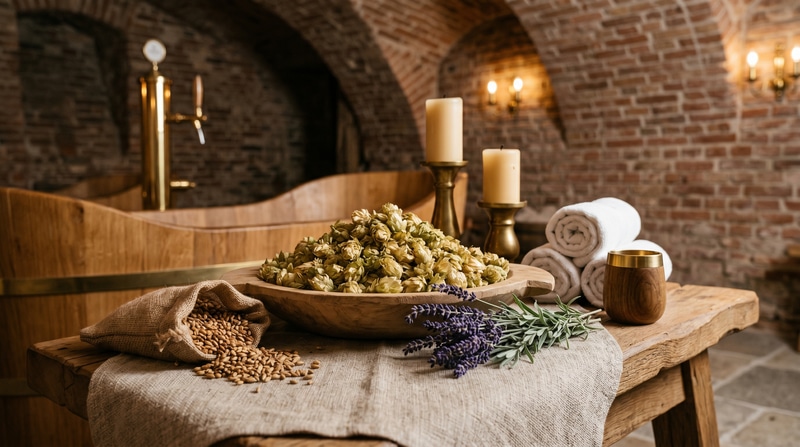
The offer is built on quality ingredients. We use Saaz hops, among the most prized varieties in the world, along with malt, yeast and Petrovicke craft beer, available on tap in light and dark varieties at the venue. Alongside beer baths we offer wine baths, classic and combined massages, and gift vouchers. The different rooms let us tailor the experience to different needs - from an intimate wellness session for two to a gathering for a larger group.
Crucially, this concept is not cut off from the history described above. On the contrary, it draws on the two strongest strands of Czech spa tradition: the conviction that nature provides the means to recover, and the understanding of the spa as a place where physical treatment blends with social pleasure. A glass of fresh beer beside a warm bath is a modern counterpart to the drinking cure at a mineral spring - a different raw material, the same spirit. Full details of the services, along with the option to book or arrange a consultation, are available directly on our site.
Tradition as a business model: expansion across Europe
The rich history and instant recognisability of Czech spa culture carry not only cultural value but real commercial potential. Demand for experiential wellness is growing steadily across Europe, and the beer spa concept unites two things the world associates with Czechia - beer and spa culture. This is the foundation on which the franchise model of Lázně Pramen is built, allowing a proven concept to travel to further cities and countries.
A franchise means the partner acquires a tested operating model, know-how, the brand and support in opening a new venue. There is no need to invent the concept from scratch or work out alone how to reconcile a historic atmosphere with a modern operation. The partner takes on a format proven in Prague and adapts it to the local market. For investors, the key point is that this is a business with a clear identity and a story that reads easily across cultures - almost everyone can picture what a beer bath is, and the link to Czech tradition lends the concept genuine authenticity.
The appeal of this model rests on several elements:
- a strong, easily communicated brand grounded in the real history of Czech spa culture
- a distinctive product that stands apart from ordinary wellness and spa centres
- a proven operating concept with carefully designed spaces and processes
- rising demand for experiential, locally rooted forms of rest
We work through the specific financial model with each candidate in a one-to-one consultation, because location, floor area and local demand shape the economics of every project. The framework itself is public: entry fee from €50,000, start-up investment from €200,000, payback in the 18-24 month range, and roughly six months from application to opening. The space requirement of at least 150 m² in a tourist zone or city centre, along with the full launch process, is set out in the franchise section. This is how a centuries-old spa tradition turns into a working business ecosystem that carries it forward - not as a museum exhibit, but as a service in live demand across Europe.
A living heritage: what history offers us today
Our journey through Czech spa culture has taken us from medieval legends of the discovery of hot springs, through the golden age of European spa life and the medical science of balneology, to the modern beer spa in Prague's Dejvice. At first glance a gulf may seem to separate a nineteenth-century Karlovy Vary colonnade from an oak tub filled with a beer bath. In truth they are bound by a firm thread.
That thread is a basic conviction Czech spa culture has carried from its earliest days: that warm water, natural ingredients, quiet and time have the power to restore body and mind. The historic spa towns developed this idea on a magnificent scale, complete with architecture, music and social life. Today's wellness carries it into a more intimate, more accessible format, but the spirit is unchanged. When you sink into a warm bath, you take part in a ritual with more than five hundred years of history in the Czech lands.
For people today, surrounded by haste and digital overload, this tradition holds unusual value. It reminds us that self-care is neither a luxury nor a weakness, but a sensible investment in health and balance. It offers a chance to slow down, to return to the body and the present moment. And it does so in a way deeply rooted in Czech culture, which is why it feels natural and authentic.
If you want to experience this tradition first-hand, we invite you to our Dejvice location, where the history of Czech spa culture meets an original concept of beer and wine baths. If, on the other hand, it is the business dimension of this heritage that intrigues you, look into the possibilities of the franchise or acquaint yourself with the opportunity for investors. For more on wellness and spa culture, visit our blog. In every one of those scenarios the asset is the same: a tradition that was never sealed off in the past but keeps working in a present-day business - proven cultural capital that the market reads without needing the explanation.
Sources
- UNESCO World Heritage Centre - The Great Spa Towns of Europe - whc.unesco.org
- Global Wellness Institute - Wellness Industry Research and Statistics - globalwellnessinstitute.org
- European Spas Association - industry body for European spa destinations - www.europeanspas.eu
- Statista - Wellness and Spa market data - www.statista.com
- McKinsey & Company - the trends defining the global wellness market - www.mckinsey.com