Why the senses matter so much in wellness
When wellness is discussed in public, the conversation tends to narrow quickly to treatments, bath ingredients or the length of a massage. Yet the final impression is shaped by a much broader mix of signals. Warmth matters. So does privacy, the acoustics of the room, the quality of light, the pacing of the visit and the way a guest perceives the space through smell. That is precisely why scent remains such a compelling subject in wellness, even if it is often reduced to claims that do not stand up to scrutiny. Lázně Pramen builds its experience around a more grounded idea of rest: baths, calm, privacy and complementary treatments that give the visit a clear purpose without leaning on exaggerated promises.
Research has long shown that people do not process their surroundings in neatly separated channels. What we see, hear and smell is combined by the brain into a single impression that influences comfort, tension levels and subjective satisfaction. In practice, that means a guest does not judge a wellness visit only by whether the bath was pleasantly warm. They also judge whether the space felt safe, whether anything disrupted them and whether the atmosphere genuinely encouraged them to slow down. Scent is not a cure-all, but it is one of the natural elements of an environment that can either strengthen the overall experience or undermine it.
For premium spa operators, that calls for restraint. It is not enough to stage an attractive setting and assign it universal healing powers. What matters far more is control over the things that can actually be managed: the quality of the space, thermal comfort, the tempo of service, privacy and a consistent guest experience. In Prague, that is well illustrated by the locations in Dejvicka. Each has a distinct character, yet both share the same priority: making sure guests feel settled and never have to manage unnecessary friction during the visit.
That, in many ways, is what makes contemporary wellness interesting. It is not about layering on ever more promises. It is about refining an environment that allows people to stop performing for a while. Add a bath, a massage and service that is properly handled, and the result feels intuitive rather than contrived. In an age of overstimulation, that sense of natural ease is one of the most valuable things a wellness concept can offer.
Scent as part of the environment, not a shortcut to miracles
Scent occupies a particular place in human experience. It can trigger memory, shape a first impression of a place and influence whether a room feels comforting, clean or intrusive. But precision matters here. The fact that one aroma feels calming to one person does not mean there is a simple, universal effect that applies to everyone. Responses to scent are individual, culturally conditioned and heavily dependent on context. In wellness, sensitivity is therefore more valuable than spectacle.
That is why it makes more sense to talk about sensory atmosphere than about miraculous effects attached to specific fragrances. If a space is over-perfumed, the result can just as easily be fatigue, a headache or the sense that the whole experience has been overproduced. By contrast, when the environment is clean, airy and the scent profile remains subtle, guests are more likely to perceive the whole setting as balanced. Expectation also plays a part. Someone arriving at a spa with the explicit aim of switching off will usually be more receptive to calming cues than someone rushing in from a workday simply trying to fit in a treatment.
In the context of other articles on the blog, it is worth stressing that wellness is not a laboratory experiment. It is a service built around lived experience. Quality is not measured by the number of fashionable terms in the copy, but by whether all the components work together. With baths and massages, that is especially important, because the body responds to temperature, touch and the quiet of the room at the same time. Scent may contribute to the impression, but it should never drown out the substance of the treatment itself.
For operators and guests alike, a simple rule holds up well: the more premium the service, the less showmanship it needs. Trust is not created by loud claims. It is created by reliable quality. When a wellness concept gets privacy, warmth, cleanliness and the rhythm of the visit right, it creates the conditions in which people can genuinely relax. If that atmosphere is then supported by a discreet sensory framework, it feels far more convincing than any marketing story built around the supposed universal power of a single fragrance.
How heat, water and ritual shape the experience
One of the strongest forces in wellness is not scent at all, but the combination of heat, water and a predictable flow to the visit. A warm bath helps the body shift out of performance mode and into a calmer state. Research on thermal comfort, relaxation and recovery suggests that heat can support a subjective sense of release and rest, particularly when paired with a quiet setting and enough time. Guests do not leave remembering only the bath itself. They remember the sequence of steps that allowed them to slow down.
Ritual is often underestimated in this context. When a visit has a clear structure - arrival, settling in, bath, rest and, where relevant, massage - both body and mind orient themselves more easily. A repeated sequence lowers mental load because the guest does not have to keep deciding what comes next. In an environment where every detail is arranged around rest, that effect becomes stronger. This is one reason private treatments are so attractive to many guests: they offer not just comfort, but continuity, without disruptive transitions.
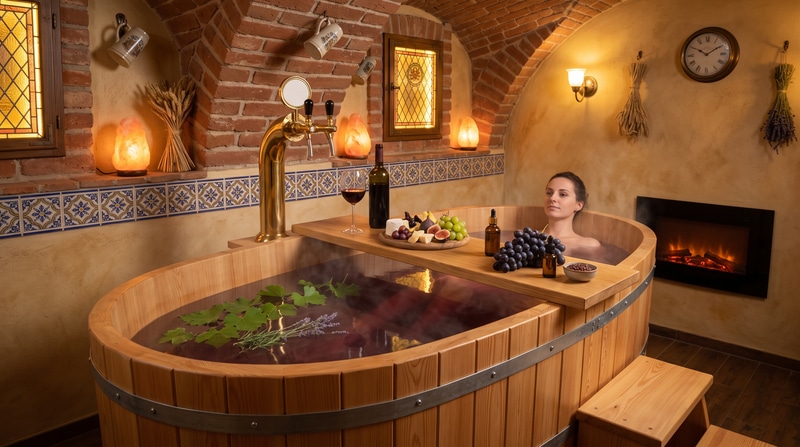
The Prague locations offer an instructive comparison between two operating concepts. At Dejvicka 255/18, Prague 6, guests encounter a more private setting, hand-built oak and larch tubs, and a wellness format designed for two. In both cases, however, the principle is the same: the treatment works best when it sits within a carefully designed rhythm and the guest can focus on rest rather than on surrounding chaos.
Heat and water also affect time perception in very practical ways. In daily life, people move constantly between tasks and digital prompts. In a spa setting, the pace slows, the body settles and even a relatively short visit can feel longer and more substantial. That is one reason bath rituals continue to hold such a strong place in modern wellness. Not because they promise the impossible, but because they create the conditions for genuine rest - something that is rarer for many people today than it has ever been.
Privacy, shared time and different forms of rest
Wellness is often framed as a universal need, but the form that rest takes is deeply personal. Some guests want silence and privacy. Others want to share the experience with a partner or a group. The ability to offer different formats without diluting quality is one of the clearest markers of a well-constructed spa concept. In practice, there is no single model of ideal relaxation. The real test is whether the service can accommodate different motivations while maintaining a clear standard.
Private space is especially valued by couples and by guests who want to switch off without outside stimuli. Silence, control over the pace of the visit and a limited number of people nearby all strengthen the sense of safety and make it easier to stop. A group-oriented setting, by contrast, can work extremely well for friends, celebrations or informal social time, provided it is organised properly. The important point is that each format should have its own logic rather than feeling like a compromise. That is the difference between an improvised operation and a thought-through wellness experience.
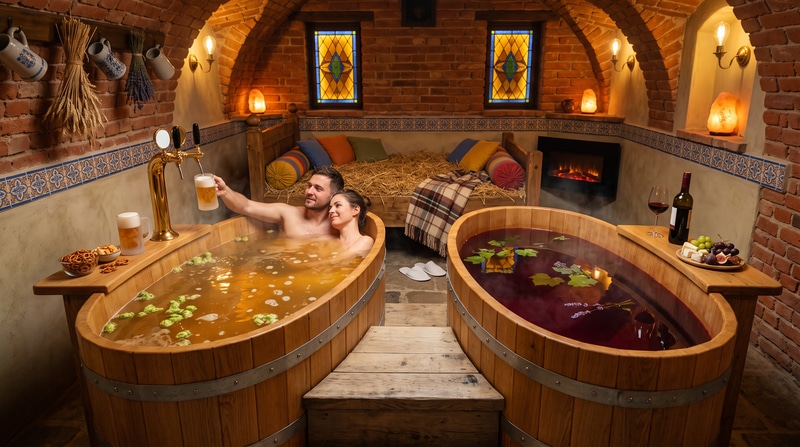
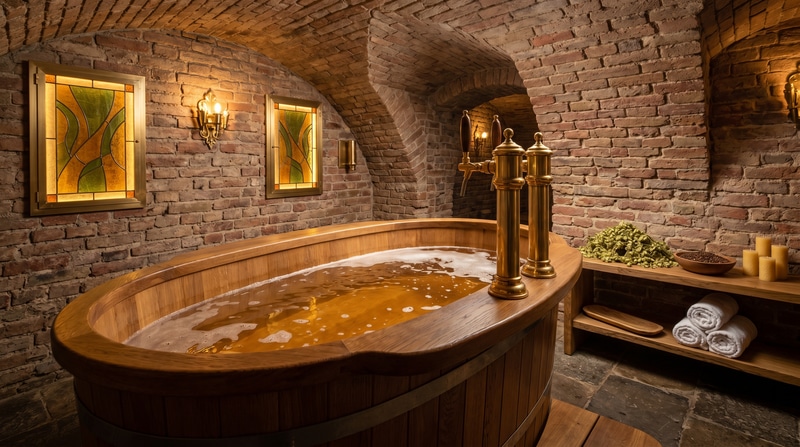
At Lázně Pramen, this distinction is visible even at the level of the Prague sites. Both locations, however, remain anchored in the same core service: beer and wine baths, classic and combined massages, private rooms and gift vouchers. Guests can decide whether wellness, for them, is an intimate ritual or a shared occasion.
This flexibility matters for broader social reasons too. Rest is no longer only an individual luxury. Increasingly, it is also a way of maintaining relationships and creating time together without digital distraction. Wellness can be a quiet space for conversation, a way to mark a special occasion or a gift that makes more sense than another object for the home. When a service is designed to work across different situations, it tends to have a much longer life than any concept built on a single passing trend.
Why massage gives a bath a stronger structure
A bath on its own can be deeply enjoyable, but it is often the addition of another well-chosen treatment that turns the visit into a complete wellness ritual. Massage has a particular role here. Its effect is not only physical, through touch and work with muscular tension, but also structural. It creates a transition either from the working day into rest, or from the bath back into ordinary life. As a result, the guest does not experience the visit as a single isolated action, but as a coherent whole.
Research on massage and relaxation techniques suggests that touch can contribute to lower perceived stress and improved overall wellbeing. That does not mean massage solves everything. It means that, in a well-structured wellness setting, it has a clear and defensible place. It is often most effective when it follows a period of settling down and the guest is no longer rushing. In other words, the value lies not only in technique, but in timing and context. A good treatment works better when it is embedded in a carefully designed visit.
That is why services that naturally complement one another make commercial and experiential sense. The offer includes beer baths, wine baths, classic and combined massages, and gift vouchers that turn wellness into a personal gift with clearly defined content. For visitors who want to understand more fully how such experiences fit into a broader idea of rest, the blog is also a useful place to explore wellness through the lens of environment, ritual and guest expectations.
Put simply, the strength of wellness does not lie in the number of items on a price list. It lies in how those items connect. The bath prepares the body to slow down, the massage deepens the release and the private setting prevents the effect from evaporating within minutes. That is also why guests often remember the atmosphere and flow of a visit more vividly than its technical details. The experience feels persuasive when everything follows naturally, without friction and without the need to prop it up with inflated claims.
Wellness as a gift that does not end up on a shelf
In an economy of excess, gifts that provide time, attention and a real experience are gaining in value. Wellness belongs naturally in that category. It is not an object that disappears into the background after a few days, but an experience with a clear beginning, a defined course and a lasting memory. That is one reason gift vouchers remain so popular: they allow the recipient to choose the right date and turn the gift into a concrete moment of rest. From a psychological perspective, experiential gifts often carry more emotional value than yet another material purchase.
Wellness also works across more life situations than many other gifts. It can be a romantic gesture, a thank-you, a birthday surprise or a corporate benefit. What matters, however, is that the voucher stands behind a clearly understandable service rather than a vague promise. When the recipient knows they are getting a bath in a private setting, or a treatment they can share with a partner or friends, the value becomes tangible. This is not abstract self-care rhetoric. It is real time reserved for rest.
That approach is also consistent with operators that want to build long-term trust. In wellness, reputation is not created by a single dramatic impression, but by repeatability. A guest who receives a voucher and experiences a calm, well-organised visit is more likely to form a durable relationship with the brand than someone who is sold an eye-catching but imprecise marketing promise. If someone wants to discuss specific options or identify the most suitable type of visit, it makes sense to use the contact page and request more detailed information.
Wellness as a gift has another practical advantage: it encourages people to plan rest deliberately. Many would not otherwise set time aside, because work and family obligations keep pushing it back. A voucher creates a gentle commitment to actually take that break. At a time when fatigue is often treated as normal, that can be surprisingly useful. Not because it promises to transform a life, but because it helps someone take one concrete step towards better balance.
When wellness works as a disciplined concept
A well-designed wellness operation is not just a collection of treatments. It is also a commercial and operational concept. That matters particularly for brands that want to grow without losing their identity. In the case of Lázně Pramen, the business is a network founded in Prague in 2007 and expanding across Europe through franchising. That kind of model requires much more than an attractive idea. It requires a clearly defined service, an understandable standard and the ability to transfer the essence of the experience across cities and markets.
Wellness is especially interesting as a model because it combines a strong experiential dimension with repeatability. Guests are not only looking for a one-off novelty. They are looking for a place they can return to on different occasions. If the concept is built around baths, massages, private rooms and an operational format that is easy to understand, it has a stronger chance of performing over the long term. At the same time, growth has to be disciplined. It is not enough to copy an interior or a name. What must travel as well is the way the guest is handled, the rhythm of the visit and the service quality that makes the brand recognisable.
From a market perspective, modern wellness is compelling because it serves several motivations at once. For some guests, it is recovery after a demanding week. For others, it is a gift, shared time or part of an urban lifestyle. That breadth of use gives concepts with a clear identity room for long-term development. For anyone interested in the business dimension - how the franchise model works or how the brand approaches expansion - official information is always more useful than generic shortcuts or rough assumptions.
That is the difference between a trend and a system. A trend captures attention briefly. A system delivers understandable value over time. For a wellness brand, that means guests know what to expect and business partners understand what is transferable. It is this combination of experience and operational discipline that determines whether one successful site becomes a stable European network.
What to take from the scent and wellness debate
If there is one practical lesson to draw from the subject of scent in wellness, it is the need for realism. Sensory atmosphere matters, but it cannot compensate for weak treatments, poor privacy or a badly run operation. Guests do not leave with a memory of one fragrance or one visual detail alone. They leave with an overall impression: whether they had enough time, whether anything interrupted them, whether the environment felt natural and whether the service delivered what it promised. That is the basis of trust in any premium wellness concept.
For visitors, the sensible approach is to choose on substance rather than on the loudest claims. It is worth looking at whether the venue offers the right visit format, how it handles privacy, which treatments it actually provides and whether its communication is factual. Clarity is an advantage here. When a brand states openly that it focuses on beer and wine baths, classic and combined massages, private rooms and gift vouchers, it gives the guest a clear framework for expectation. And clear expectations are often the first step towards satisfaction.
The same principle applies at the commercial level. Anyone considering an investment or a broader franchise concept should look for brands built on operationally credible services rather than fashionable language. In wellness, long-term winners are rarely those who promise the most. They are the ones that can deliver a quality experience consistently. For those considering cooperation, it is always better to discuss the detail through the official contact page, where a specific consultation can begin.
Scent unquestionably belongs in wellness, but as part of a larger whole. Its real value appears only in combination with warmth, water, quiet, touch and a well-designed environment. When those elements work together, there is no need to embellish the story. The experience speaks for itself. And that may be the greatest luxury in wellness today: not promising more than is possible, but offering rest that is honest, intelligible and genuinely pleasurable.
Sources
- Global Wellness Institute - Industry research - globalwellnessinstitute.org
- McKinsey & Company - Customer experience insights - mckinsey.com
- Statista - Spa & wellness industry data - statista.com
- European Spa Association (ESPA) - Industry standards - europeanspas.eu
- Harvard Business Review - Customer experience - hbr.org