Why it pays to choose wellness by experience, not trend
When people start looking for a wellness break, they often begin with broad intentions. They want to switch off, recover, do something restorative for themselves, or plan an enjoyable programme for a partner or a group of friends. In practice, however, the quality of the experience is rarely determined by the latest fashionable label. What matters is a more concrete mix of factors: how much privacy you want, what kind of setting feels right, how long the visit should last, whether a bath should be paired with a massage, and whether you are coming alone, as a couple or in a group. That is why it makes more sense to choose wellness around the kind of rest you actually want, rather than the loudest marketing message. If you want to compare different approaches to relaxation, the blog from Lázně Pramen offers further perspective.
Lázně Pramen has operated in Prague since 2007, with a concept built around a clearly defined experience: beer and wine baths, classic and combined massages, private rooms, and the option to choose a setting that fits the occasion. That matters because guests are not all looking for the same thing. One person wants an intimate wellness visit for two. Another is after a livelier venue suited to a small group. Someone else is primarily choosing a gift voucher that feels personal while remaining practical. In Prague, the brand operates two distinct venues - Legerova 758/60, Prague 2 for groups and corporate wellness, and Dejvická 255/18, Prague 6 for private visits - and the contrast between them shows exactly why wellness should be treated as a tailored experience rather than a generic category.
Long-running research consistently points to the value of rest, lower stress levels and deliberately carved-out time away from routine as positive influences on mental wellbeing and perceived quality of life. That does not mean every treatment works equally well for everyone. Quite the opposite. Some people relax best in silence and seclusion; others respond better to the social energy of a shared programme. Some see the bath as the centrepiece of the visit; others do not consider the experience complete without a massage. The purpose of choosing well is to match the format of the visit to expectations, so the result feels considered and personal rather than standardised.
This article therefore avoids inflated promises and invented service claims. Instead, it focuses on practical choices: how to decide between private and shared settings, when a beer bath makes more sense than a wine bath, how massage fits into a wellness visit, what to consider when choosing a Prague location, and how to think about a gift voucher so it genuinely lands well. Get those decisions right, and it becomes much easier to find a form of relaxation that suits your pace and the occasion you actually have in mind.
Privacy or a shared experience: the first choice that changes everything
The most important question in choosing a wellness visit is often not which treatment is on the menu, but what kind of environment you want to experience it in. Privacy has a direct effect on the pace of the entire visit. In a more intimate setting, people tend to unwind faster, pay less attention to those around them and settle more easily into the experience itself. That is one reason many couples actively look for wellness venues where they do not need to share the occasion with strangers. If calm, discretion and the freedom to enjoy the visit at your own tempo matter to you, it makes sense to focus on private rooms and smaller, more intimate operations.
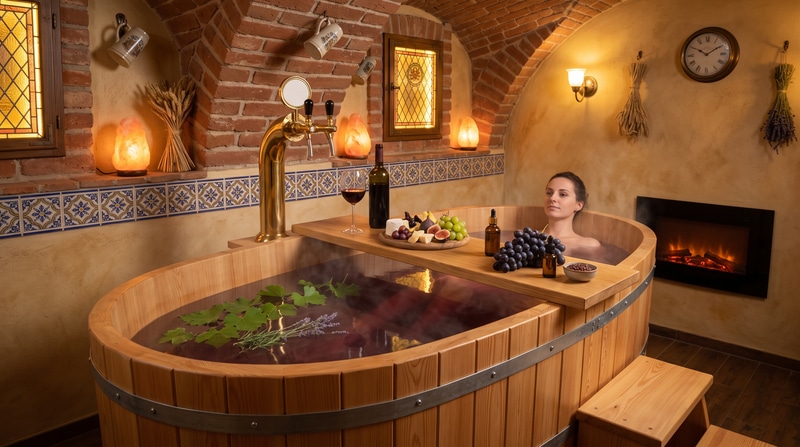
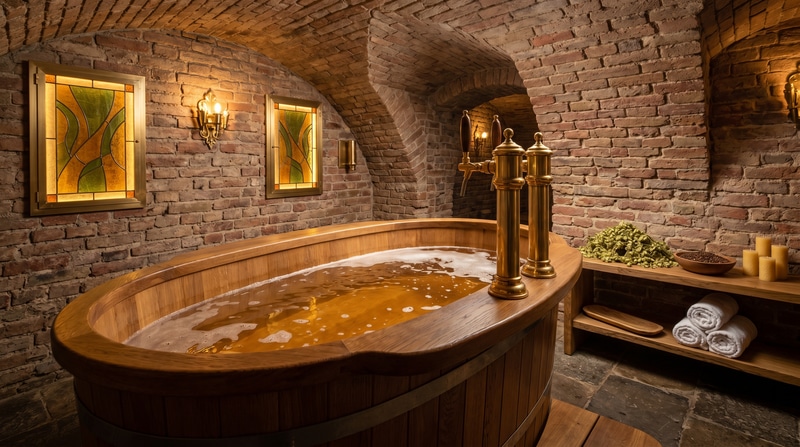
Within the Prague branches of Lázně Pramen, that distinction is represented clearly by two addresses. Dejvická 255/18 in Prague 6 is designed as the more private concept, with handmade oak and larch tubs and a strong emphasis on wellness for two. It is the kind of setting that works well for anniversaries, dates, a quiet reset after a demanding week, or a carefully chosen gift for a couple. Neither format is inherently better. The decisive factor is what you want the visit to feel like.
Psychologically, the difference between private and shared wellness is significant. A private environment supports a sense of safety and limits the number of stimuli a person has to process while trying to relax. A group setting can do the opposite in a positive way, strengthening the social dimension of the experience and turning wellness into part of a celebration, reunion or informal programme. Before booking, it helps to answer a few simple questions:
- Am I looking primarily for quiet and calm, or do I enjoy a livelier atmosphere?
- Am I booking for two, or choosing a programme for several people?
- Should the visit feel romantic, celebratory or more social?
- Do I need a private room, or is overall capacity more important?
- Do I want intimacy to define the experience, or shared enjoyment?
That first decision often determines whether the whole visit feels natural. Many disappointments do not stem from the service itself, but from choosing an environment that does not fit the mood or the occasion. Anyone who wants to enjoy wellness properly should therefore start with atmosphere and privacy. Only then does it make sense to weigh up the specific type of bath or massage.
Beer and wine baths as two distinct forms of relaxation
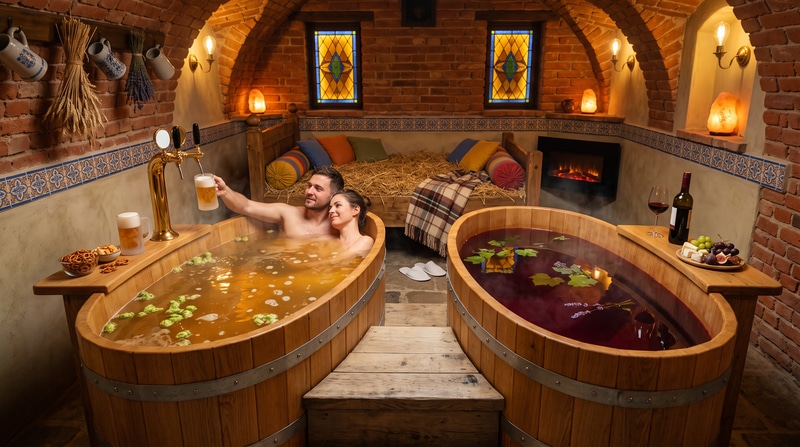
Once you know whether you want privacy or a more social experience, the next major decision is the type of bath itself. At Lázně Pramen, the choice is between beer baths and wine baths - two formats that differ not only in atmosphere, but also in the symbolic and experiential cues they carry. A beer bath is often associated with Czech tradition, informal comfort and a more characterful, original kind of wellness. A wine bath, by contrast, tends to feel softer, more ceremonial and, for many guests, more romantic. This is not a case of one being universally better than the other. The sensible approach is to choose according to mood, occasion and personal preference.
There is also a cultural layer to experiential wellness. In the European context, both beer and wine carry strong social meaning and, for many guests, represent more than a drink. They are tied to ritual, gathering and leisure. When that motif is carried into wellness, the result is not just a treatment but a particular atmosphere. A beer bath can therefore be ideal for a couple wanting something distinctive and locally rooted. A wine bath works especially well where guests are looking for a quieter, more elegant and visually softer tone to the visit. In both cases, the key point is that these are not interchangeable experiences. They are two different routes into relaxation.
It helps to think about the choice in practical terms. In particular, consider the following:
- What sort of atmosphere do you want from the visit - more playful, or more intimate?
- Is this a gift for a couple, a shared programme with friends, or personal downtime?
- Will the bath be the main point of the visit, or part of a broader wellness session?
- Is originality more important to you, or a more ceremonial feel?
- Do you want something anchored in the Czech setting, or a more universally elegant option?
The choice between a beer bath and a wine bath is therefore less about theory and more about context. Some guests return repeatedly to the same format because they know exactly what suits them. Others alternate depending on season, mood or occasion. Both approaches are perfectly reasonable. What matters is that the treatment aligns with what the wellness visit is meant to deliver: a slower rhythm, a pleasant ritual and a moment that does not feel interchangeable with an ordinary day.
When it makes most sense to combine a bath with massage
Many guests choose wellness primarily by the bath, yet the real quality of the experience is often shaped by what follows it. At Lázně Pramen, the menu includes classic and combined massages, and that matters because guests do not all arrive with the same need. Some want to release physical tension after long hours of sitting and one-sided strain. Others are looking for a broader sense of calm and a smoother conclusion to the visit. A bath and a massage do not need to be viewed as two separate services. Chosen well, they form a coherent sequence in which each part reinforces the other.
From the standpoint of subjective experience, the combination of warmth, a slowed-down setting and subsequent manual care has an obvious advantage: the guest does not need to switch abruptly between different kinds of stimulus, and the visit gains a natural rhythm. Instead of relaxation ending the moment you step out of the tub, it can continue seamlessly. That continuity is often why people remember a wellness visit as genuinely restorative rather than simply as a one-off treatment. Research into massage interventions suggests that massage can contribute to lower perceived stress and short-term improvements in psychological wellbeing, especially when it forms part of a broader recovery routine.
The bath-plus-massage combination tends to make the most sense in several situations:
- When you want the visit to feel like a complete ritual rather than a short stop.
- When you are choosing a gift that should feel comprehensive and well thought through.
- When you have a sedentary job and need not only mental decompression but physical release as well.
- When you are visiting as a couple and want the experience to have a clear beginning, high point and calm finish.
- When you want to reserve a block of time that will not be fragmented by other activities.
That said, a massage does not need to be an automatic part of every booking. For some guests, the bath on its own is entirely sufficient and matches exactly what they expect from wellness. The real question is whether you want a brief pause or a longer, more deliberate space for recovery. If you are unsure which combination is right, it is sensible to ask for more information through the contact page before booking. A well-judged visit rarely happens by accident. It comes from matching the format of rest to the guest's actual needs.
How to choose the right branch for the occasion and group mix
In Prague, the decision is often shaped not only by which treatment you choose, but by where you have it. Location affects the logistics of the day, ease of access for guests and the overall impression of the visit. In wellness, that matters twice over, because relaxation does not begin only once you are in the tub or on the massage table. It starts with how easily you reach the venue, whether the setting fits your plans and whether the operation suits the nature of the occasion. That is why it helps to think of individual branches not as interchangeable addresses, but as distinct formats within the same concept.
At Dejvická 255/18, Prague 6, you will find two different answers to the question of what wellness should feel like. Dejvická is better suited to guests looking for privacy, a more intimate environment and wellness for two. The handmade oak and larch tubs reinforce a sense of craft and intimacy. From a practical standpoint, that difference should be one of the first filters when booking. A couple planning a quiet anniversary will think differently from a group of friends arranging a shared programme.
A simple framework can help:
- For a romantic or highly personal experience, choose the more private setting.
- For a group programme, consider the branch that is naturally equipped for more guests.
- If wellness is part of a broader day in the city centre, location may carry more weight.
- If your priority is calm and a sense of separation from the city's rhythm, focus on the more intimate atmosphere.
- If you are choosing a gift, think about which type of space will feel most natural to the recipient.
The right branch is not the one that is best in general terms, but the one that best fits your situation. That distinction matters. In premium wellness, quality is not measured only by fittings or treatment menus, but by whether the guest leaves feeling that the entire environment matched expectations. When location, branch format and the character of the visit align, the result feels coherent and free of unnecessary compromise.
A gift voucher as a considered experience, not a fallback option
Wellness gift vouchers are sometimes underestimated because people associate them with a last-minute solution. In reality, they can be among the strongest gifts precisely when they are chosen thoughtfully. Unlike physical items that often end up underused, an experience offers something the recipient is more likely to make time for. In the case of Lázně Pramen, a voucher makes particular sense because the offer is not a single uniform service. The recipient can choose from several variables - a beer or wine bath, a classic or combined massage, a private room, a more intimate setting for two, or a space better suited to a group.
That flexibility is what makes a gift voucher effective across different situations. For a couple, it can mean uninterrupted time together. For parents, it may be a welcome prompt to slow down for a while. For a colleague, close friend or business partner, it can work as a refined and practical gift that is not overly personal, yet does not feel impersonal either. The important thing is not to choose the voucher mechanically. If you know whether the recipient values privacy, prefers a quieter or more social atmosphere, and would appreciate a massage as part of the visit, the voucher becomes a highly targeted gift rather than a generic one.
A few practical rules help when choosing:
- For anniversaries and partner gifts, wellness for two in a more private setting usually works best.
- For friends or a smaller group, it makes sense to consider the branch with greater capacity.
- If you are unsure about preferences, a more universal experience format is the safer choice.
- For people with demanding working lives, the combination of bath and massage is often especially valuable.
- The best gifts are not the most expensive ones, but the ones that best fit the recipient's life situation.
Another advantage of a wellness gift is that its purpose is clear: to create space for rest. At a time when many people are dealing with overload, fragmented attention and too little time, that can feel surprisingly personal. If you need help choosing the right option or clarifying which branch and visit format would suit the recipient best, the practical route is to ask via the contact page. A well-chosen voucher is not a backup plan. It is a deliberate invitation to spend time well.
What a wellness brand's history and operating model say about quality
When choosing wellness, people often focus on photography and treatment lists. Just as important, though, is the story behind the brand and the logic of how it operates. Credibility is not created by aesthetics alone. It comes from longevity, a clear concept and the ability to deliver a consistent experience over time. Lázně Pramen was founded in Prague in 2007, which is a meaningful detail in the experiential wellness segment. It signals that this is not a short-lived project built on a passing wave of popularity, but a concept that has proved itself over time and found a stable audience.
It also matters that the brand is not built around a random assortment of services. The offer is easy to read: beer baths, wine baths, classic and combined massages, private rooms and gift vouchers. That structure is useful for guests because it makes the decision process simpler. Rather than navigating an overloaded menu of dozens of treatments, they are presented with a clear framework in which to choose according to occasion and preference. In premium wellness, that can be more valuable than excessive breadth, which often ends up feeling fragmented. Quality is expressed not only in the number of options, but in how well the individual elements fit together.
Another important signal is the business model. Lázně Pramen operates as a franchise network expanding across Europe. For an ordinary guest, that is not merely a corporate footnote. It implies that the concept is defined and transferable enough to grow beyond its original market. In practice, that usually points to standardisation of the key elements of the experience, a clear brand identity and operational discipline. For those interested in the broader business dimension, more detail on the franchise model and opportunities for investors is available separately, but from the guest's perspective the key point is simpler: the visit is underpinned by a firmly structured concept.
History, clarity of service and a well-designed operating framework are therefore not abstract corporate ideas. For the guest, they amount to practical reassurance that the wellness experience will not feel improvised. That reassurance is often one of the main reasons people return to a particular place.
What to clarify before booking so wellness meets expectations
Even a strong wellness concept can lose part of its appeal if the guest underprepares and books too vaguely. The most common mistake is not choosing the wrong service, but failing to define the context in advance. A couple trying to carve out a calm evening after a long stretch of routine needs something different from a group of friends arranging a shared programme. Before booking, it is therefore worth thinking not only about the type of bath, but also about timing, group composition and the main outcome you want - deep calm, a shared experience, or a balance of both.
The preparation itself does not need to be complicated. It is usually enough to answer a few concrete questions and then choose the branch, treatment and visit length accordingly. If privacy is essential, it makes sense to focus on the more intimate setting. If you are planning for several people, you should take into account the branch naturally suited to groups. In the same way, it helps to decide whether you want only a bath or a bath plus massage. This simple preparation often determines whether wellness feels like genuine rest or merely another item inserted into an already crowded day.
Before booking, clarify in particular:
- How many people are coming and what kind of atmosphere will suit them.
- Whether the main focus should be a beer bath, a wine bath, or a combination with massage.
- Whether you want a private room or a space better suited to a more shared experience.
- Whether this is a personal visit, a gift, an anniversary or a group occasion.
- Which of the Prague branches is the better fit for your plans.
If you are unsure, the best approach is not to guess but to ask. A direct consultation through the contact page can help clarify the differences between branches, the suitability of a specific treatment and the best way to structure the experience. That extra step is particularly worthwhile for gifts or important occasions. Wellness should function as a space for recovery, not as another source of organisation stress. The more precisely you define your expectations in advance, the greater the chance that the visit will deliver what you want from it - calm, focused time and the sense that you chose well.
Sources
- Global Wellness Institute - Industry research - globalwellnessinstitute.org
- McKinsey & Company - Customer experience insights - mckinsey.com
- Statista - Spa & wellness industry data - statista.com
- European Spa Association (ESPA) - Industry standards - europeanspas.eu
- Harvard Business Review - Customer experience - hbr.org