Design as part of the investment, not as aesthetics
When a partner is planning a new Lázně Pramen franchise, the interior is the heaviest line of the budget. Not operationally – financially. Civil works, tubs, water technology, lighting, acoustics, and the finish layer (brick, wood, brass) together take 30–40 % of the start-up investment. On a typical €250 000 package (€50 000 entrance fee plus €200 000+ launch), that is €60–100 thousand.
The single number an investor cares about when entering the wellness space is the payback. Ours sits at 18–24 months and holds an EBITDA margin of 30 %+ – not because the interior is beautiful, but because it is standardised across the network. Standardisation means the franchisee is not paying an architect to design from scratch. They are paying for the execution of a proven concept already running across three sites and a hundred thousand guests.
This article breaks down where the money goes in a Lázně Pramen interior, where the savings sit and where the return shows up. Not trends – numbers.
The industrial-cellar concept and why exactly this look
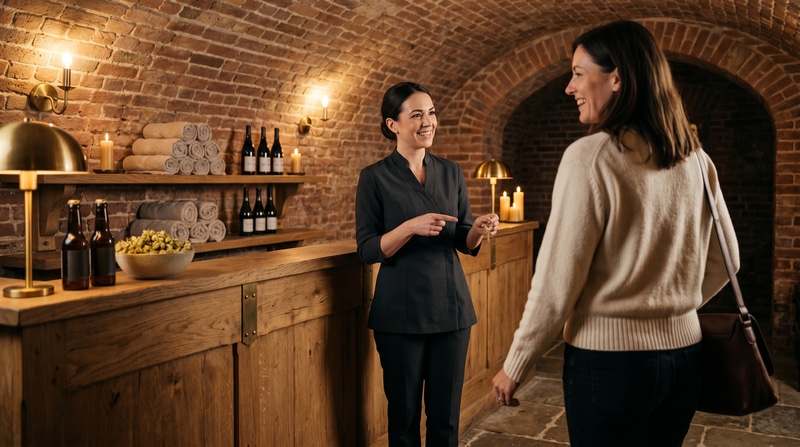
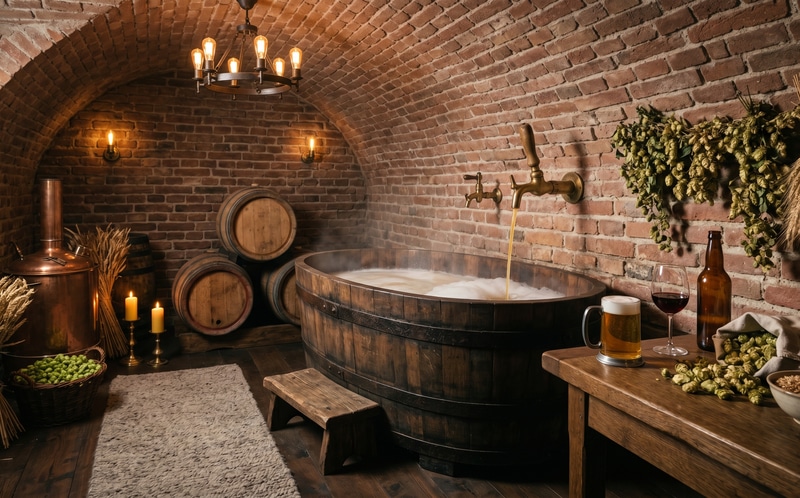
The Lázně Pramen aesthetic is not a styling choice – it is a cost strategy. Instead of soft-luxury (marble, glass, neutral palettes) used in hotel wellness, we have committed to industrial-cellar: brick vaults, hand-finished wood, brass, dimmed 2700 K warm light. The net result is a look the guest remembers and materials that don't devalue.
The brick vault in a basement carries two values at once – architectural (it is real, the guest sees it) and financial (laid once, brick holds 50+ years with no maintenance). Marble in hotel wellness looks luxurious for two years, then scratches. Brick reads "premium-rustic" for as long as the building stands.
The second advantage: brick and dark wood naturally fit the craft beer and winemaking narrative we sell. Soft-luxury wellness does not. A guest who books a beer or wine bath expects brick, barrels, a fireplace. White marble breaks the story before the first sip.
Oak and larch tubs vs acrylic: the material economics
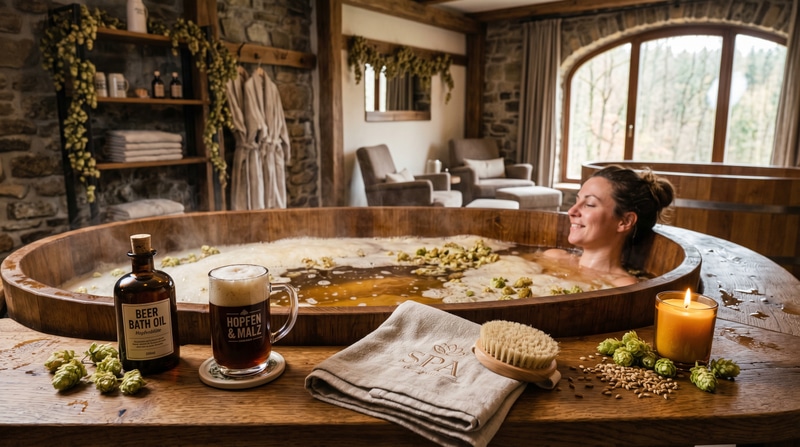
The centrepiece of every private room is a 1,000-litre hand-crafted oak or larch tub. For an investor comparing to acrylic tubs in classic spas, the numbers on the table are:
- Lifespan. Properly maintained oak or larch tub: 15–20 years. Acrylic tub: 5–7 years, then replaced (acrylic is effectively non-recyclable, it goes to landfill).
- Price per guest. A guest pays €60–80 for a 90-minute bath. In a plastic tub the same price doesn't sell – "premium" perception is the wood. The Global Wellness Institute reports guests are willing to pay 20–30 % more for eco-premium format.
- Depreciation. A 15-year wooden tub gives a lower annual cost per unit of revenue than a 5-year acrylic tub, even with a higher initial purchase price.
- Maintenance. Wood needs seasonal oiling (1–2× a year, €30–50 of materials). Acrylic, once damaged – full tub replacement.
Tubs are part of the franchise pack – you don't source them yourself. The supplier is centrally selected and every site gets an identical unit. Another saving: no bespoke joinery quotes, no certifications, no logistics.
Lighting, acoustics, HVAC – where franchisees usually leak money
Three "invisible" layers of the interior where inexperienced operators routinely lose money:
- Lighting. Wellness demands warm light 2200–2700 K, dimmable, zero flicker. 4000 K LED panels (standard office) in a bath environment read clinical – the guest leaves feeling they visited a hospital. Our franchisee spec uses brass shades and high-CRI (90+) bulbs – €15–25 per fixture, but the gap between €60 per 90 minutes and €40 per 90 minutes.
- Acoustics. A brick vault is acoustically hard. Without absorption (linen drapes, wool rug, wooden ceiling battens) the whirlpool roar and voices from the next room bleed everywhere. Lázně Pramen standard: reverberation time < 0.8 s in the relax zone. In numbers – €2–4 thousand for sound treatment per site.
- HVAC. A 1,000 l tub at 35–38 °C generates 2–3 kg of water vapour per hour. Without active recovery and dehumidification, the brick starts to mould after two years. Central MVHR system: €15–20 thousand; restoring brick after under-ventilation: €50–80 thousand. Not a question of if – a question of pay now or pay later.
All three numbers are laid out in the design package so the franchisee sees them on the original budget. Without that they would surface in year three as an unplanned spend.
Biophilia our way: hops, wood, copper, brick – not green walls
Biophilic design – bringing natural elements into the interior – gets reduced in hotel wellness to green walls and concrete planters. That is expensive (a living wall is €600–1,200 per m², plus irrigation and €300/month maintenance) and tonally wrong in a brick cellar.
Our take on biophilia is material, not decorative. We read the 14 patterns of biophilic design (Browning, Ryan, Clancy – Terrapin Bright Green) through the Beer & Wine Spa concept. Instead of houseplants we have:
- Dried Saaz hop cones in the decor (€4/kg, sourced 100 km away) – part of the brewing-tradition narrative;
- Wheat straw as the post-bath bedding – a functional element of the procedure, not decoration;
- Hand-built oak and larch in the tubs – the strongest natural element in the room;
- Brass taps and details – a nod to copper brew kettles;
- Brick as the main wall finish – the "organic past" of the concept.
The guest reads it the same as classical biophilia (calm, nature, authentic materials). For us it costs an order of magnitude less and needs zero maintenance. For the franchisee it is a traceable, easily reproducible style without depending on specialist green-wall suppliers.
Dejvická as the design reference
The flagship site, Lázně Pramen Dejvická, sits in a 19th-century basement – original brick vaults, stone sills, no panels, no plasterboard. Four private rooms:
- Zlatý pramen – two oak tubs, capacity 4 guests, for corporate sessions;
- Rubínový pramen – one oak tub, intimate setup for a couple;
- Smaragdový pramen – combined room with a wine tub and a cedar phyto-sauna (V.I.P. tier);
- Safírový pramen – salt cave with massage table, support space.
Total floor area 150 m². That is the minimum floor plate we recommend to a new franchisee. On that footprint a 4-room matrix runs with a peak capacity of 8 simultaneous guests – the cap that one front-of-house can hold to standard.
When a candidate franchisee comes to a site visit, they walk Dejvická metre by metre: where the tubs sit at the wall interface, where the electricals terminate, where the HVAC extraction hides. Not as "inspiration" but as a drawn solution.
What our design package includes for franchisees
The franchise pack includes a full design document set:
- Architectural drawings – 4-room and 6-room matrices, proven at Dejvická and in the rollout pipeline;
- Material specifications – exact brick type, oak grade, textile weights, U-values where openings exist;
- Lighting plan – fixture positions, colour temperature, output, dimming protocol;
- HVAC specifications – airflow rates, dehumidification, MVHR recovery;
- Central supplier list – tub joinery, brass tap maker, Bernard brewery, Saaz hop source;
- Project oversight – pre-opening site audit by our architect, deviation log against the standard.
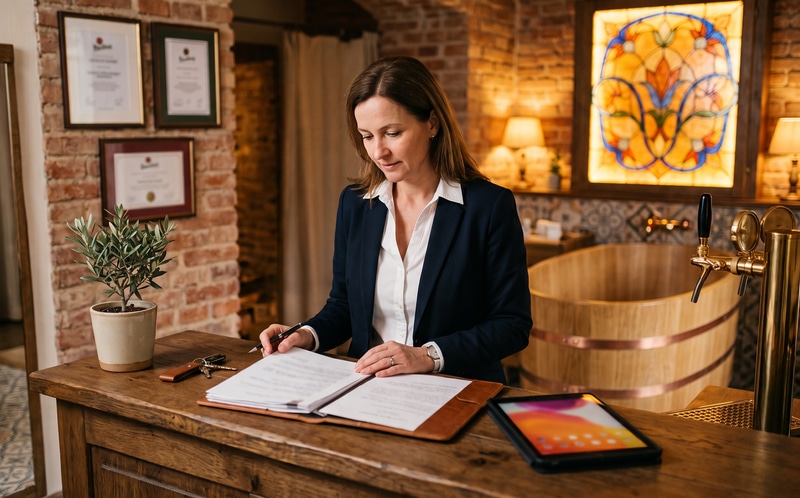
For the new franchisee that means no decisions to make on the concept. The local architect is engaged for site coordination, not design. Typical saving on design fees vs opening a standalone wellness concept: €20–40 thousand.
Interior ROI: the actual numbers
Back to the question we opened with. What does a properly standardised interior actually buy you in numbers:
- Price per session. Premium interior holds €129–€253 per private room (90 minutes, 1–4 guests). In hotel "spa lounge" formats the comparable session sells at €40–60 per guest – one third of the revenue per occupied tub;
- Repeat visits. 85 % of our guests return within twelve months. The top driver in the post-visit survey: "environment" (74 %) followed by "procedure quality" (62 %);
- Rating. 4.8/5 on Tripadvisor across the network. "Interior" appears as a term in 38 % of five-star reviews;
- EBITDA margin. 30 %+ sustained. Standardised material and process specs cut operating costs by 12–18 % against an unstandardised wellness concept (internal data benchmarked against three independent peers).
For an investor considering joining our network, the interior is the first number on the investment memo and the last number that comes back as an operational edge. To walk through a specific budget for your city, get in touch – we will send a detailed CAPEX breakdown across 12 categories so you can see every line.
Sources
- Browning W., Ryan C., Clancy J. – 14 Patterns of Biophilic Design – Terrapin Bright Green – terrapinbrightgreen.com
- Global Wellness Institute – Global Wellness Economy Monitor 2024 (USD 6.3 trillion market) – globalwellnessinstitute.org
- McKinsey & Company – The trends defining the global wellness market – mckinsey.com
- International Franchise Association – Franchise Economic Outlook – franchise.org
- Statista – Spa & wellness industry market data – statista.com
- European Spa Association (ESPA) – Industry standards – europeanspas.eu