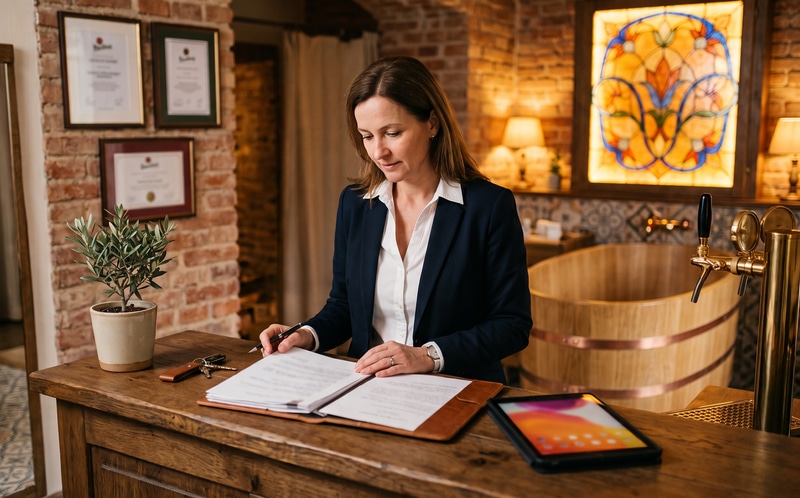
Why the legal framework decides whether a spa succeeds
From the outside, opening a beer or wine spa looks like a romantic venture - oak tubs, the scent of hops, contented guests. The reality is that between the idea and the first paying visitor sits a dense web of legal obligations that determine whether the business is even allowed to operate, and whether it will survive its first inspection. Lázně Pramen has been in the market since 2007, and over that time the legislation has been rewritten more than once. That experience taught us a simple lesson: legal preparation is not an administrative box to tick, it is the foundation stone of a safe and durably profitable operation.
A spa sits inside several regulatory regimes at once. It carries health and hygiene elements (baths, hot water, skin contact), food-safety elements (Petrovické zlato on tap, both light and dark, poured for guests to drink in the tub), building and technical elements (bath technology, drainage, ventilation) and consumer elements (service contracts, gift vouchers, complaints). Each of those areas has its own supervisory authority and its own penalty regime. Underestimate any one of them and the result can be a fine, forced closure or, at the extreme, criminal liability.
This article works through the key legal pillars of running a spa in the Czech environment in a systematic way - from hygiene standards through trade licensing and food safety to consumer protection, data privacy, and the specifics that anyone weighing entry into a franchise network must confront. The aim is not to replace a lawyer, but to hand the operator a map of the terrain, so they know what to ask and where not to cut corners. Legal compliance is not a cost. It is an insurance policy on the entire value of the business, and a precondition for the owner sleeping soundly.
Hygiene standards: the heart of any bathing venue
The most sensitive and most closely watched part of running a spa is hygiene. A venue where guests step into a warm bath at 35-38 degrees Celsius is, in the eyes of the regulator, a facility where infections can spread and micro-organisms multiply if maintenance is not properly managed. Oversight is exercised by the regional public health authorities under the public health protection act and the implementing decrees that govern bathing facilities, saunas and comparable installations.
The central document is the operating protocol, which every venue must draw up and submit for approval. It sets out the water-treatment technology, how often the bath is changed, the cleaning and disinfection procedures for tubs between guests, wastewater handling, and the minimum hygiene requirements for staff. At the Dejvice flagship, the bath is drained completely after every guest and the tub is sanitised - a fundamental difference from pool operations that recirculate their water, and the cleanest model hygienically possible.
The specific duties an inspector will check include, above all:
- keeping operating records and logs of disinfection and water changes,
- proof of medical fitness for staff who come into contact with guests,
- certificates and safety data sheets for the disinfectants in use,
- a supply of drinking water of adequate quality and monitoring of bath temperature,
- separate storage for clean and soiled textiles (towels, sheets),
- functioning ventilation and extraction in the higher-humidity cellar spaces.
The hand-built oak and larch tubs bring aesthetic and sensory value, but they also demand more careful upkeep than plastic baths - the wood must be treated so that it does not absorb dirt and can withstand repeated sanitation. That is why a sound operating protocol also includes a maintenance schedule for the wooden surfaces. An operator who keeps these records diligently holds a huge advantage during an inspection: they can demonstrate that hygiene is not an accident but a managed process.
Trade licensing and how the activity is classified
Before the first tub is filled in a private room, the operator needs their trade licensing in order. Running a spa is not a single, homogeneous activity - it combines several trades that must be notified or for which the relevant authorisation must be obtained. Wellness and spa services generally fall under a free trade, specifically the field covering physical-fitness and regeneration services, or the operation of facilities used for regeneration and recovery.
Matters grow more complicated once massage enters the picture. The classic and combined massages we offer as a complement to the baths fall under a qualified trade where they are recovery or sports massages. That means the person delivering the massage must prove professional competence - relevant education or an accredited retraining course. The operator therefore cannot simply hire anyone; they must verify the qualification and keep evidence of it.
A third layer is the sale and serving of drinks. Because guests drink poured beer during the bath itself, a hospitality trade is added, which is again a qualified trade. That carries the obligation to appoint a responsible representative with the appropriate experience or education if the entrepreneur does not hold the competence personally. Misclassifying the activity is a classic beginner's mistake, and it leads to fines for unauthorised business.
For anyone entering our franchise network, this whole process is considerably simpler - the franchisee receives a verified list of the required authorisations, template documents and methodological support, so there is no need to navigate the legislation from scratch. Even so, a trade licence is always tied to a specific person and a specific venue, and it cannot be taken over mechanically. Anyone who wants to talk through their own situation can use an introductory consultation, where we go through the precise requirements for a given city and business form.
Food safety and pouring beer inside the venue
The fact that beer is poured straight into the tub moves the operation partly into food-safety law. The moment an entrepreneur handles drinks intended for consumption, they become the operator of a food business and take on obligations under both the European food-hygiene regulation and the Czech food act. Oversight here is exercised by the state agriculture and food inspection authority, and, for the operational hygiene element, again by the regional public health authority.
The basic tool is a HACCP system - hazard analysis and the definition of critical control points. Even in a small operation with one or two beers on tap, it must be documented in writing how kegs are tapped, how the dispensing lines are cleaned, how product is stored at the correct temperature, and what the shelf life is. Regular sanitation of the beer lines is decisive not only for taste but precisely for safety - a neglected line is a source of microbial contamination.
The practical duties tied to serving drinks include:
- keeping HACCP documentation and records of cleaning the dispensing equipment,
- records of suppliers and traceability of keg batches,
- observing the ban on serving alcohol to anyone under 18,
- visible allergen information for the drinks and add-ons served,
- storage at controlled temperatures and records of cooling temperatures.
Liability for serving alcohol deserves particular attention. The operator is responsible for not serving a person who is visibly intoxicated beyond a reasonable point, and must handle situations where a guest combines a hot bath with drinking. Warm water speeds the absorption of alcohol and dilates the blood vessels, so staff must be trained to recognise the risk and to know when to offer water rather than another beer. That is why our methodology includes not only recipes for the perfect bath but also rules for safe service. Anyone weighing the model as an investor should understand that this operational discipline directly protects the brand's value against reputational risk.
Contracts, vouchers and consumer protection
Every bath booking is, in legal terms, a service contract concluded between the operator and a consumer. Most owners never register this until the first complaint or dispute over a refund. Yet Czech consumer protection, set out in the civil code and the consumer protection act, lays down fairly specific rules, and breaching them exposes the business to penalties from the Czech trade inspection authority.
Gift vouchers are a crucial area, since they account for a significant share of every spa's revenue - a popular present at Christmas, anniversaries and birthdays. The issues here concern the length of validity, the option to extend it, and what happens to unused value once the voucher expires. The operator must clearly inform the customer in advance of the validity period and the conditions for redemption. Where a voucher covers a specific service that has been paid for up front, the customer cannot be asked to top up the price simply because the price list has since risen, unless that was part of the agreement.
A second sensitive point is the right to withdraw from a distance contract. When a guest books and pays for a bath online, that is a distance contract. The law, however, recognises an exemption for leisure services provided on a set date - typically spas, restaurants and experiences - so for a booking tied to a specific date and time the usual fourteen-day withdrawal period generally does not apply. But this exemption has to be applied correctly and disclosed in advance, otherwise the business cannot rely on it.
The recommended minimum of transparent terms includes:
- a clear price list and scope of service stated before the booking is made,
- cancellation terms with reasonable deadlines and any applicable fees,
- rules on the validity and redemption of gift vouchers,
- details of the body for out-of-court resolution of consumer disputes,
- a complaints procedure available both on site and online.
Anyone who wants to see how transparently we communicate our own terms will find further inspiration among the pieces on our blog. Well-drafted terms and conditions are not bureaucracy - they are the boundary markers that protect both sides and head off disputes before they arise.
Data protection and medical contraindications
A spa processes surprisingly sensitive data. Beyond the ordinary contact details in the booking system, we come into contact with information that borders on health data - guests tell us about the contraindications that make a hot bath unsuitable. Pregnancy, cardiovascular problems, high blood pressure, acute infections or skin conditions are all details on which staff decide whether to admit a guest to the bath at all. That is precisely why the operation is fully subject to the European General Data Protection Regulation, GDPR.
The operator must have a defined legal basis for every act of processing. Contact details for a booking are processed on the basis of performing the contract; marketing outreach with further offers is typically based on consent or legitimate interest, with an easy way to opt out. Where information about medical contraindications is concerned, particular caution is warranted: it should be gathered only to the extent necessary, ideally as a declaration by the guest rather than the storage of sensitive medical records, and it should not be kept longer than needed.
The practical measures that should be present in every spa include an intelligible privacy policy published on the website, security for the booking system and any camera recordings, clearly set retention and deletion periods, and processing agreements with external suppliers - the provider of the booking software or the accountant, for example. A camera system in the venue, where one exists, must be properly signposted and must not intrude on intimate spaces such as the private rooms with the tubs themselves.
Medical contraindications also carry a second dimension - responsibility for the guest's safety. The operator should have a written procedure for informing guests at the outset about the risks of a hot bath and alcohol consumption and about when a bath is inadvisable. This briefing protects not only the guest but the business too, should a health complication arise after the bath. The combination of an honest briefing, proportionate data handling and trained staff is the best defence against disputes over liability for harm to health. We are happy to explain the details of our methodology in a personal consultation.
Building, technical and safety requirements for the venue
The physical space of a spa must satisfy a range of building, technical and fire requirements that are often underestimated, because they are not obvious at first glance. Our Dejvice flagship, a cellar-style venue of 150 square metres with four private rooms - Zlatý pramen, Rubínový pramen, Smaragdový pramen and Safírový pramen - is a case study in a venue where the ventilation of a humid environment, drainage from 1,000-litre tubs and safe hot-water distribution all had to be resolved. Cellar spaces bring atmosphere, but also technical demands.
The starting point is a building-use approval or consent to use the premises for the specific purpose. A space originally designated for a different use cannot simply be turned into a spa - a change of use requires cooperation with the building authority. Tied to this is an assessment of the layout in terms of hygiene, the number of sanitary facilities, accessibility where the law requires it, and escape routes.
The key technical areas that inspectors and the fire service check include:
- fire safety design, marked escape routes and fire extinguishers,
- electrical installation in a high-humidity environment and inspections of electrical equipment,
- adequate ventilation and moisture extraction from cellar spaces,
- hot-water distribution and heating sized for large-volume tubs,
- safe connection to the sewer system and wastewater handling,
- anti-slip surfaces and mitigation of the slipping risk around the tubs.
Our operating format does not vary by city but by the particular room inside a single venue - an intimate wellness experience for a couple raises different layout requirements from a larger group booking. That is exactly why we settled on four separate rooms, each with its own facilities and character. For anyone considering entry into the franchise network, this means the space must be chosen with these technical parameters in mind from the very start - converting a building that is unsuited to large-volume baths usually costs more than searching out a better space in the first place. Technical due diligence on the premises is therefore the first step we recommend to every future partner.
The legal specifics of franchising and brand protection
Joining a franchise network adds one more layer on top of all the duties described above - the relationship between the franchisor and the franchisee. Czech law has no standalone franchising statute, so this relationship rests on the general law of obligations in the civil code, on intellectual property law and on competition law. That makes a precisely drafted franchise agreement all the more important; it is the central document of the entire relationship and should be written to protect both sides.
Our franchise agreement addresses, above all, the licence to use the trademark and know-how, the territorial scope, the term and conditions of termination, the operating standards the franchisee must uphold, and the financial terms. The model rests on a €50,000 franchise fee and ongoing royalties of 6 % of revenue plus a 2 % contribution to the shared marketing fund; the launch investment starts at €200,000 depending on the city and the state of the premises, which puts the total package at €250,000+. The full breakdown for a specific location is laid out in the franchise section.
The core legal value of a franchise lies in the trademark and a uniform standard. A franchisee is not buying a manual on how to fill a tub - they are buying a proven brand, the trust of guests, and a methodology that shortens the time to opening and reduces the risk of errors. The control mechanisms in the agreement reflect that: the franchisor reserves the right to check compliance with hygiene, operating and visual standards, because a single below-par site damages the reputation of the whole network. That is why the standards are so detailed - they are not restrictions but a guarantee.
For an investor weighing a spa as a business opportunity, it is therefore essential to assess not only the earnings potential but the legal robustness of the whole concept - the quality of the agreement, the clarity of the rules, and the level of support in mastering licences and hygiene. Our partner-entry process is built to move systematically from the first conversation through location verification and contract preparation to the opening itself, without legal gaps. Anyone who wants to discuss a specific step can reach us through the contact form and arrange a no-obligation meeting where we go through both the legal and the operational side of the whole plan.
Sources
- WHO - Guidelines for safe recreational water environments - www.who.int
- European Commission - Food hygiene legislation and HACCP - food.ec.europa.eu
- European Commission - General Data Protection Regulation (GDPR) - commission.europa.eu
- European Spa Association (ESPA) - European spa industry standards - www.europeanspas.eu
- Global Wellness Institute - Wellness industry research - globalwellnessinstitute.org
- International Franchise Association - franchising legal and business resources - www.franchise.org