Why the vine is worth an operator's attention
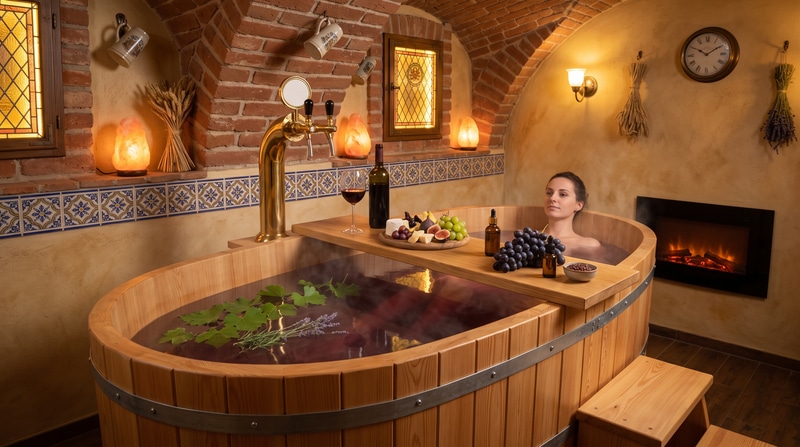
Most wellness inputs are chemistry with a marketing layer applied afterwards. The grape is different in a way that matters commercially: it arrives with the cultural code already installed. Wine needs no explanation to a guest in Prague, Vienna or Bratislava. The water in the tub is a deep burgundy that photographs without help. And the raw material is a by-product of an industry the guest already respects, which means the supply story survives a follow-up question. Recognition, visible drama and a defensible origin in one ingredient is rarer than a supplier catalogue makes it look.
It also creates a specific exposure. A wine line invites claims. Suppliers make them, brochures repeat them, and by the time the wording reaches the front desk it has usually grown. The operator is the one who stands behind it in front of a guest and, in the EU, in front of a regulator. So this piece does the split a treatment menu has to do anyway: what the grape genuinely delivers, what is still laboratory work, and what belongs in somebody else's sales folder.
The angle throughout is operational. Lázně Pramen has run beer and wine baths since 2007, works today from its flagship at Dejvická 255/18 in Prague 6, and offers the concept to partners across Europe as a franchise. Everything below is written from the position of the person who has to buy the oil, store it, train the staff who apply it and answer for what the price list promises. Related pieces on operating economics and concept design sit on the blog.
Polyphenols: what a spa may promise, and what it may not
The mechanism is real and it is modest. Polyphenols are compounds the plant makes to survive its own environment - ultraviolet light, oxidative stress, fungal attack - and they act as radical scavengers on human skin as well. In grapes the useful fraction concentrates in the seeds, as proanthocyanidins; the skins carry the anthocyanins that give a dark variety its colour. Whether any of that does measurable work depends on three unglamorous variables: how much is in the product, whether the molecule survives storage, and whether it reaches the skin at all.
That last variable is why this belongs in an operator's briefing rather than a chemist's. A spa makes claims in more places than it counts: the price list, the website, the voucher text, the sentence a receptionist improvises when a guest asks what the bath is for. Cosmetic claims in the EU are regulated and have to be substantiated. Claims that a treatment cures, heals or treats a condition are not claims a spa is entitled to make at all - that is medical territory, and a wine bath is not a medical device.
The fix is cheap, and it is a training problem rather than a legal one. Write the menu in the language of care and experience instead of outcome. A bath is what it is made of, how warm it is, how long it lasts and how the guest feels afterwards. All of that is describable without a single therapeutic verb, and it sells better than a vague promise because it is concrete. Hand the front desk two or three sentences they can actually say and they will stop inventing their own.
One physiological statement does hold up and is worth using. Warm water at 35-38 °C widens the peripheral vessels, so the skin is warm and softened by the time the guest leaves the tub - which is the honest reason a bath before a massage works better than a massage on its own. Treat anything a supplier adds on top of that as their claim, not yours, until they hand over the file that supports it.
Resveratrol: a premium name that degrades on the shelf
Resveratrol is the one grape compound a guest might recognise by name, and recognition is worth money on a retail shelf. It sits in the anti-ageing category, it has been in the literature long enough to be familiar outside the laboratory, and a supplier who puts it on a label expects to be paid for it. For a spa that runs a small retail counter beside the treatment rooms, that name is a genuine commercial asset - it shortens the conversation before a sale.
The catch is not chemical trivia, it is stock control. Resveratrol dissolves poorly and oxidises quickly in light and air. A product built around it starts losing value the moment the packaging is opened, and in a treatment room packaging gets opened and then used slowly. What a guest paid a premium for can quietly become a jar of something less by the end of the quarter. Nobody complains about that; they simply do not rebook.
So the handling rules are ordinary retail discipline. Buy in packaging that protects the contents. Keep opened stock out of daylight. Rotate against the turnover the room actually has, not against the printed expiry date. Size orders to what gets used rather than to the discount on the larger unit. The wider rule is not to build a menu on one molecule: a line that depends on a single fragile active ingredient is a line whose quality moves with your delivery schedule.
Keep the caveat in the staff script as well. The photoprotective properties quoted in supplier material are studied mostly in laboratory models. Resveratrol is not sun protection, and a guest told otherwise by a well-meaning therapist has been given advice the spa cannot stand behind.
Grape seed oil and extracts as working stock
Grape seed oil is the part of the vine that earns its place in a stockroom. It is light, it absorbs fast, it is high in linoleic acid, and it leaves no film - so it works on oily and combination skin as well as on dry, and a therapist does not have to decide which bottle suits the guest in front of them. That is a purchasing argument before it is a skincare argument: one oil across the whole massage menu instead of three specialised ones, with one supplier to manage, one shelf life to track and one price to negotiate.
It is also a by-product. The seeds come out of winemaking, which gives a franchisee something most wellness sourcing lacks - a supplier with a name and an address. A working relationship with a regional winery is a practical option rather than a slogan, and it hands the front desk an answer that survives the second question. Guests ask where things come from more often than menus expect them to.
Extracts from the skins are the second fraction worth buying. Darker varieties carry more anthocyanins and more resveratrol, so the variety behind an extract is a specification and not a detail. Extraction method matters for the same reason: heat and aggressive solvents destroy exactly the compounds being paid for, and a supplier who cannot describe their process is selling an unknown.
Which leads to the unglamorous part that decides whether the line holds together. Ask for batch documentation. Check that the stated shelf life is compatible with how quickly a room really works through a container. Compare deliveries against each other, because an oil that smells and behaves differently from one batch to the next produces a treatment that feels different to a returning guest, and inconsistency of that kind is what a network cannot absorb. At Lázně Pramen ingredient sourcing sits inside the operating standard rather than beside it.
What a wine line looks like in a real treatment room
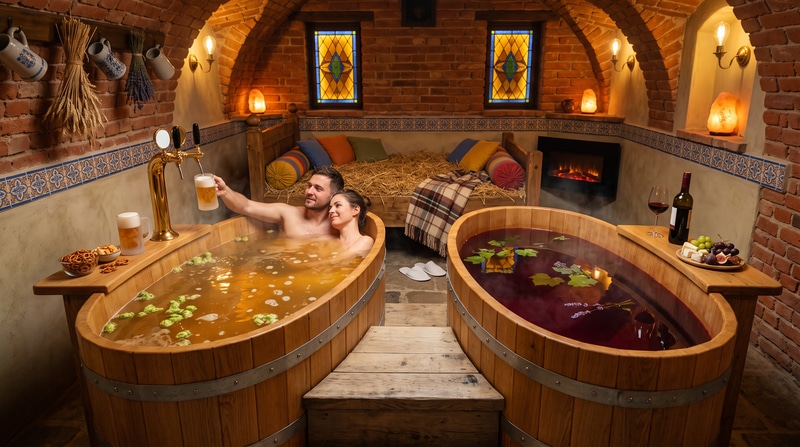
At the Dejvická flagship the wine line runs in four private rooms, each with its own name and its own job. Zlatý pramen holds two tubs and takes two to four guests, which makes it the couples-and-small-groups room. Rubínový pramen and Smaragdový pramen have one tub each, Smaragdový being the V.I.P. room. Safírový pramen is the salt cave: massages only, no tub. The names are Czech proper nouns and they stay in Czech in every market, because the room is part of the brand rather than a description of the furniture.
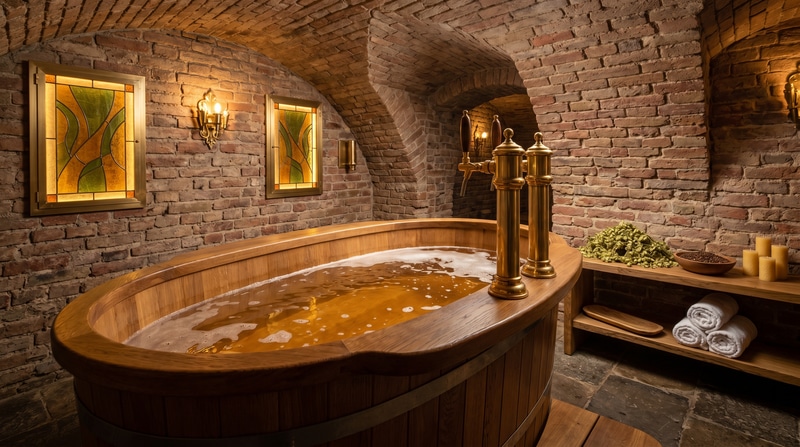
The tubs are the capital item, and an investor reading this deserves them stated plainly. Each holds 1,000 litres, each is hand-built - oak in Zlatý pramen, larch in Rubínový and Smaragdový - and the service life runs 15 to 20 years. That is a long amortisation for the single object a guest is most likely to photograph. Water sits at 35-38 °C.
The bath and massage pairing is where a grape line pays for itself twice. Grape seed oil works as the carrier and as the active ingredient, so one purchase covers both halves of the ritual: the guest leaves the tub warm, the therapist works with an oil that suits whatever skin they find, and the second half of the visit needs no separate product range. Booking the two together is the natural upsell, and it is the one a receptionist can offer without sounding like a salesperson.
One operational point that planning decks routinely skip: throughput is set by turnaround, not by the booking grid. Filling, draining and cleaning a 1,000-litre tub between guests takes real time, and a schedule drawn without it reads better than it will ever run. Anyone modelling a location should ask about turnaround before multiplying slots by price. Lázně Pramen sizes the room count around that constraint rather than against it.
Buying the line: how to judge a supplier
Choosing products for a treatment room is a procurement decision, and it usually goes wrong in one specific way: the person choosing reads the packaging the way a consumer would. A consumer buys a single jar and lives with the result. A spa buys a line, puts it in the hands of staff who have to use it the same way on every shift, and then defends whatever the label implies. Different job, different criteria.
Start with the ingredient list, because it is the cheapest signal on offer. INCI ordering is by descending quantity, so the position of an active compound tells you roughly what you are buying without a single laboratory test. A grape extract sitting near the end of a long list is a garnish. That is not automatically a reason to reject the product; it is a reason not to pay a premium for it.
Packaging is a hygiene question in a treatment room before it is a chemistry one. Opaque tubes, dark glass and pump dispensers keep light and air off unstable actives, and they keep fingers out of the product between guests. An open jar fails on both counts at once. Dosing is the quiet third argument: a pump gives a therapist a repeatable amount, which is how a treatment stays the same across two therapists and two shifts.
Then ask for paper. A safety assessment. Dermatological testing where the line touches sensitive skin. Batch consistency you can check rather than trust. A shelf life measured against your real turnover instead of an ideal one. A supplier who cannot produce these quickly is a supplier nobody has asked, which tells you something about their other customers. The short version for a buying checklist:
- position of the actives in the INCI list, since the ordering is by quantity
- packaging that protects the contents and keeps hands out of the product
- a safety assessment, plus dermatological testing where the line meets sensitive skin
- documented batches and a shelf life that matches how fast the room works through stock
- provenance you can name out loud, ideally a winery whose processing you can point to
- no promises of instant results
That last item is the one that costs money later. A supplier promising instant wrinkle removal is not selling a product, they are selling a liability: the wording migrates into your price list, a therapist repeats it, and the operator is the one who answers for it. Buy from people whose claims you would be comfortable printing under your own logo, because that is precisely what happens.
The ritual is the product
What a guest buys is a sequence, not a bathtub. Arrival and a few minutes to slow down, then the bath, then rest on the heated straw bed, then the massage - in that order, with the timing worked out so that no part of it feels either rushed or padded. A competitor can buy the same tub from the same joiner. What they cannot buy off a shelf is the order of operations and the small decisions inside it.
Which is what a franchise actually sells. Not a recipe and not a plate on the door, but the fact that the sequence is written down and repeatable: a brand book, operating manuals that cover the parts of the day nobody thinks to document, staff training at the Prague flagship before opening, and webinars afterwards for the questions that only appear once the room is live. A new location does not have to rediscover the running order by trial and error on paying guests.
Gift vouchers deserve their own line here, because they are a channel rather than a merchandising detail. They sell in a different season from the visits they eventually produce, they are bought by people who are not the guest, and they flatten a booking calendar that would otherwise track tourism and weather. Plan for them from the first month instead of discovering them in December.
There is also the part of the product that no ingredient list captures. An hour in warm water, in a room with no clock and with the phone somewhere else, is why a good share of the guest list comes back, and it is why they describe the visit afterwards in terms of how they felt rather than what was in the water. Say that plainly in the menu and leave it there - it does not need to be dressed up as physiology. Lázně Pramen sells the sequence; the grape is part of what the sequence is made of.
The economics, and the way in
A wine line is not a business by itself. It is one stream inside a room that also runs beer baths, massages, vouchers and a retail shelf, and that is the part worth grasping before any figure: the model holds up because it is spread across several modest streams, not because one of them carries a heroic margin. A location living off a single high-priced service is fragile in exactly the months nobody controls.
The Lázně Pramen franchise is published rather than negotiated case by case. The franchise fee is €50,000. Start-up investment begins at €200,000, which puts the total package at €250,000 and upwards depending on the site. Royalty is 6% of turnover plus 2% into the marketing fund, with the first three months royalty-free. Typical payback is 18-24 months. Monthly running costs land between €15,000 and €25,000 depending on the size of the branch, and financing is normally obtainable for 60-70% of the total investment.
On the site itself: from 150 m². That is the minimum requirement for a new location and not a description of Dejvická - it is the floor below which the room count stops working, not a measured area of the flagship. From signature to opening takes about six months, and very little of that is paperwork.
The risks belong in the same register as the figures. Footfall decides more than the fit-out does: a wine spa is a destination purchase, but it still lives or dies on where it sits and who walks past the door. Seasonality is real, and vouchers only smooth it, they do not remove it. And renovation is the largest and least predictable line in the start-up budget - an older building in a good street can absorb the gap between the low and the high end of the total package before a single tub is delivered. Anyone who says otherwise has not opened one.
The detail sits where it should. Terms are on the franchise page, the capital side is set out for investors, and specific questions go through the contact form. The grape is a good ingredient with a real supply chain and a story that holds up under questioning. Whether it becomes a business depends on the room it goes into and on the numbers above.
Sources
- Global Wellness Institute - wellness and spa market research - globalwellnessinstitute.org