Why a gift voucher is more than a marketing gesture
To most guests a gift voucher is a simple thing. You buy it, you hand it over, and one day the recipient trades it for an experience. For the operator of a spa, it is something considerably more intricate - a financial instrument that simultaneously moves cash, inflates the liabilities line in the accounts, triggers tax obligations and feeds into the occupancy of private rooms. Sell vouchers as nothing more than a pretty card, without thinking through their economics, and you forfeit one of the most attractive advantages the whole model offers. You also expose the business to risks that only surface months later.
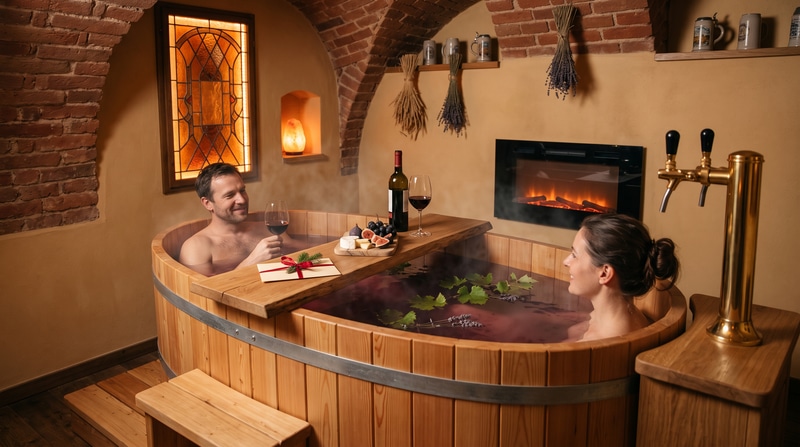
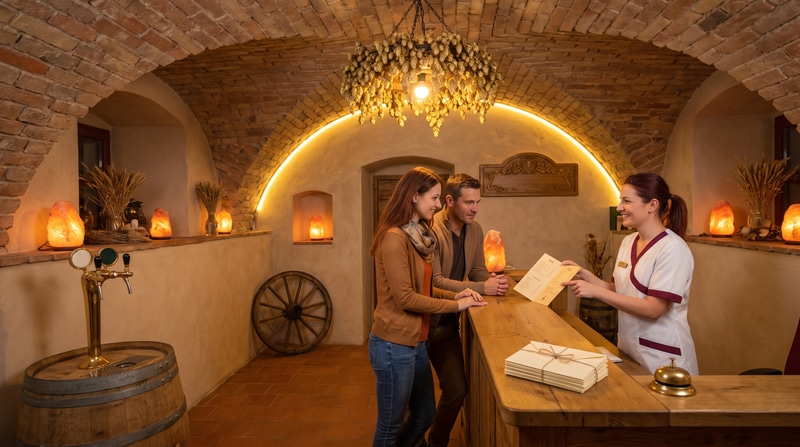
Within the Lázně Pramen network, gift vouchers sit on the menu alongside beer and wine baths and the classic and combined massages. The experience a guest wants to give away takes place in the four private rooms of the flagship venue: Golden Spring (Zlatý pramen), Ruby Spring (Rubínový pramen), Emerald Spring (Smaragdový pramen) and Sapphire Spring (Safírový pramen). It is precisely this pairing - prepaid sales set against a fixed room capacity - that forms the heart of the economic question. Money arrives today, the experience is consumed later, and the places where it can be redeemed are finite.
This article does not treat the voucher as a promotional item. It treats it as a balance-sheet line. We will work through the prepaid capital and its effect on cash flow, the problem of unredeemed value (breakage), the way a voucher is booked as a liability, the difference between a single-purpose and a multi-purpose voucher under EU VAT law, and the particulars of bulk corporate and discount-portal sales. The aim is to give both the operator and the prospective franchisee a practical framework for setting their own voucher policy - one that supports the numbers rather than becoming a silent accounting burden.
Prepaid capital and the flow of cash
The single largest and most direct benefit of gift vouchers is interest-free prepaid capital. When a guest pays for a voucher in November and the recipient only arrives for their bath in February, the spa holds that cash for three months against a service it has yet to deliver. In the pre-Christmas run-up, when voucher sales traditionally peak, a substantial volume of money pours into the venue at the very moment staffing, raw-material and operating costs are climbing. That head start can absorb seasonal swings and reduce the need for working-capital borrowing.
For a single venue with a fixed number of rooms, however, prepaid capital carries a downside: concentrated demand. Vouchers bought before Christmas are rarely redeemed evenly across the year. A large share of recipients want to use them in the first few months, or conversely right before the expiry date. When that redemption spike collides with the fixed capacity of four rooms at the flagship, a bottleneck forms. Guests cannot get the slot they want, and satisfaction drops among exactly the people who did not buy the experience for themselves.
The operator therefore has to view prepaid capital through two lenses. On the cash side it is a welcome advantage, one worth actively encouraging - by pushing voucher sales outside the main season, for instance. On the capacity side it is a commitment that must be steered through the booking system so redemption spreads out over time. Practical levers include:
- incentives to book weekday or off-season slots
- clear communication of the validity period at the point of sale
- tracking the ratio of sold to redeemed vouchers through the year
- keeping prepaid funds recorded separately from ordinary revenue
Once these principles are written into the standards of the whole franchise network, every new venue inherits a proven framework and never has to learn prepaid-capital management by trial and error.
The voucher as a liability on the books
In accounting terms, a sold gift voucher is not revenue. At the moment of sale the spa takes in cash, but it simultaneously creates a liability - the obligation to provide a service in future, or to refund the money. Revenue is recognised only when the guest redeems the voucher and actually takes the bath or the massage. Until then, the funds sit on the balance sheet as deferred income, not in the profit-and-loss account as earnings. The distinction is fundamental, and small venues all too often underrate it, because they see cash in the account and mistake it for profit.
The consequence is very practical. An operator who spends every penny of the pre-Christmas voucher takings may discover in the new year that services must now be delivered for which no cash remains. Prepaid capital is, after all, also a debt owed to guests. A healthy policy therefore assumes that part of the prepaid funds is tied to future delivery and should not be spent as free profit.
The international revenue-recognition standard addresses this exact scenario. It sets out when and how the liability from prepaid cards and vouchers is moved into revenue, and how to treat the portion that will probably never be redeemed. Professional practice adds that vouchers should be recorded separately, tracked by date of sale, and their balances reviewed on a regular basis. For the operator this means keeping records from which it is clear at any moment how much voucher value is still "out there" awaiting redemption.
For investors weighing an entry into this sector, it is worth understanding that a well-run venue does not report the volume of vouchers sold as net profit, but as a mix of cash and liability. That discipline is a mark of sound management, and it separates a sustainable operation from one that lives off prepaid capital while hiding its own future costs.
Unredeemed value: what breakage is and how to manage it
Not every voucher gets used. A share of them lapse - the recipient forgets, mislays the card, misses the expiry date or simply never shows up. In accounting language this unredeemed value is called breakage, and for the operator it is a distinctive line item, because the money has already been collected yet the corresponding service is never rendered. From a trading perspective it is revenue carrying no variable cost - but it must not be recognised prematurely, and it has to respect both accounting and consumer rules.
Audit Analytics, drawing on companies' SEC filings, puts breakage typically at 2-4 percent of gift-card sales, and estimates have ranged from about 7-8 percent in 2008 to under 1 percent by 2015. Those are figures for US retail gift cards, though. For a spa with a personal, experience-led product and a limited validity window, these patterns will look nothing like those of a retail chain's universal prepaid card. You cannot simply borrow someone else's numbers; every venue has to track its own data.
The revenue-recognition standard gives clear guidance on breakage: expected unredeemed value can be released into revenue gradually, in proportion to how guests redeem the rest of their vouchers, rather than booking the entire lapsed sum in one lump once validity expires. That smooths the accounts and prevents accounting jumps. Sound record-keeping calls for:
- tracking the redemption rate separately for each sales period
- estimating expected unredeemed value from your own history
- recognising breakage gradually, not in a single hit
- respecting statutory rules on validity and consumer rights
The ethical and legal dimension bears emphasising: breakage must never become a commercial strategy built on guests failing to redeem in time. Consumer law protects voucher holders, and a fair operator sees unredeemed value as a natural by-product, not a goal. Within the Lázně Pramen network, clear communication of validity at the point of sale is accordingly part of the standard of care for every guest.
VAT on vouchers: single-purpose versus multi-purpose
The area where operators most often slip up is VAT. The European Union harmonised the tax treatment of vouchers through Directive 2016/1065, the so-called Voucher Directive, in force since 2019. It distinguishes two basic types, each taxed differently - and the distinction between them determines whether VAT is accounted for at the point of sale or only on redemption.
A single-purpose voucher is one where the place of supply and the VAT rate are already known at the moment of issue, because it is clear exactly which service it will be exchanged for. For this type, VAT is accounted for when the voucher is sold. A multi-purpose voucher, by contrast, is one where, at the time of sale, it is not yet definitively settled which service or goods - potentially carrying different rates - the guest will choose. As expert commentary on the EU rules explains, VAT on a multi-purpose voucher applies only at the moment it is actually used, not when it is sold.
For a spa venue, then, the crucial question is how its vouchers are structured. A voucher for one specific service at a single rate falls under a different tax regime than a universal voucher for an open amount, redeemable against baths, massages and ancillary sales at varying rates. This decision bears directly on when the tax liability arises and how prepaid capital is handled. A sound approach involves:
- clearly deciding whether the voucher on offer is single-purpose or multi-purpose
- aligning the tax treatment with the services the voucher can be redeemed against
- consulting specific rates and procedures with a tax adviser
- standardising the solution across the whole network so it is auditable
This text quotes no specific rates or national percentages, because the correct set-up always depends on current legislation and on the particular structure of the offer. For a franchise network expanding across Europe, however, a consistent reading of the voucher types is exceptionally valuable: the rules stem from a common EU directive, so the underlying logic travels between countries even where the detail differs.
Corporate orders and sales through discount portals
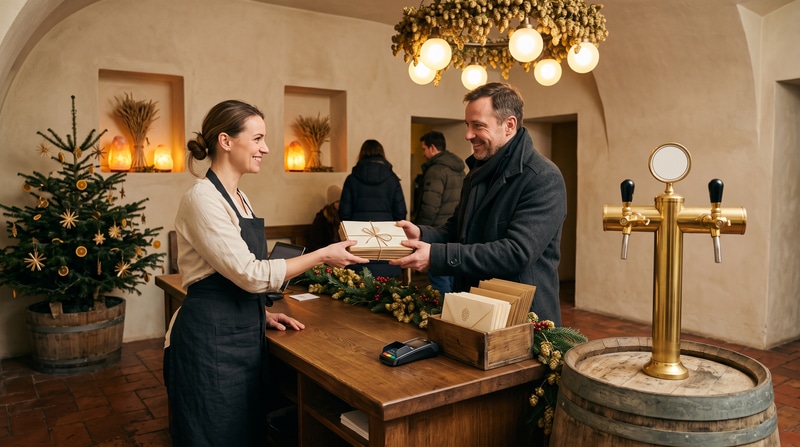
Where an individual guest buys a single voucher, companies buy by the dozen. Bulk corporate orders - vouchers as Christmas gifts for staff, rewards for business partners, or part of an employee-benefits programme - form a sales channel of their own, with its own economics. One corporate order brings in more prepaid capital in a single stroke than a great many individual sales, and it creates a matching liability that has to be managed just as carefully.
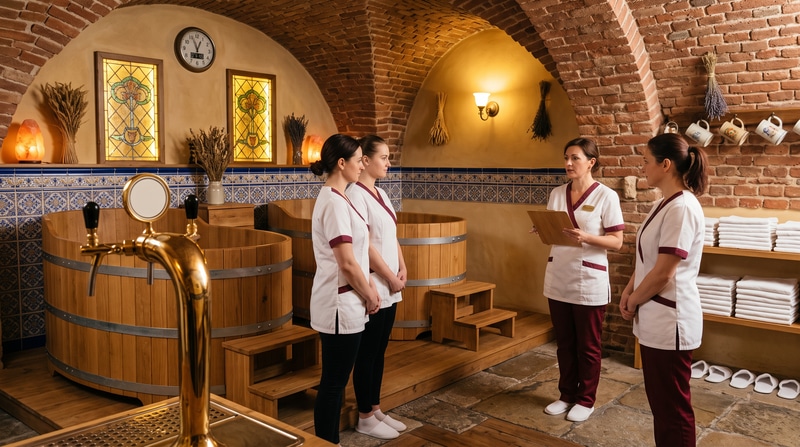
Corporate sales carry both upsides and risks. The upside is volume and predictability: a corporate client often returns every year, and orders can be planned for. The risk is concentrated redemption - when a firm hands out fifty vouchers before Christmas and the recipients start cashing them in over the same winter stretch, the collision with the fixed capacity of four flagship rooms is even sharper than with dispersed individual sales. This is exactly where the variety of room formats helps. Golden Spring, with its two tubs for two to four people, can take a larger group, while Ruby Spring and Emerald Spring target intimate couples' wellness. A corporate wave can thus be spread out according to the makeup of the groups.
The second distinctive channel is selling through discount portals. It delivers reach and new guests, but at the cost of a markdown plus the portal's commission, so the net yield per voucher is markedly lower. Discount vouchers also tend to attract one-off customers with a lower return rate. For the operator this means weighing reach against margin and not relying on the channel as a primary source of sales. A sensible policy covers:
- distinct pricing and terms for corporate, individual and portal sales
- managing the redemption of bulk orders through the booking calendar
- using the different rooms to spread both group and couples' demand
- judging discount channels by net yield, not by volume
Anyone interested in a partnership or a corporate order will find more via the contact page, where specific terms can be arranged according to the size and timing of the order.
Gift vouchers in the context of a growing wellness market
Gift vouchers are not an isolated phenomenon. They are one of the routes by which people enter the growing field of experiential wellness. Global analyses describe the spa and wellness sector as a long-term grower, powered by rising incomes, an expanding middle class, the boom in wellness tourism and consumers' deepening interest in self-care. The gift voucher is a low-threshold gateway: someone who might never buy a beer or wine bath for themselves will try it as a gift, and a portion of those guests come back as paying clients.
For an experiential spa with a one-of-a-kind product - a bath with Žatec hops, malt and yeast, and Czech craft beer on tap right at the tub - the voucher is the ideal way to reach a fresh audience. A gift functions as a recommendation: the recipient gets not only the experience but also an implicit vote of confidence from someone they know. In a field where personal recommendations are stronger marketing than advertising, that effect represents real economic value you will never read off the sheer volume of vouchers sold.
Bathing together, local traditions and experiences shared with a partner or friends are exactly what a beer spa offers - culturally rooted, visually striking and easy to give. A voucher is therefore not merely a financial instrument but a marketing channel that works on the operator's behalf, even out of season.
From the standpoint of network growth, then, it pays to see vouchers as part of customer acquisition rather than simply prepaid revenue. If a new guest arrives on a gifted bath and returns as a regular client, they repay many times over the value of the original voucher. Every investor and every venue in the Lázně Pramen network setting its long-term sales strategy should keep that perspective in mind.
In summary: voucher policy as part of running the venue
A gift voucher is at once a marketing tool, a source of prepaid capital, an accounting liability and a tax item. An operator who handles all these layers at the same time gains an instrument with an exceptionally good benefit-to-cost ratio: cash arrives early, a share of vouchers brings in new regular guests, and properly managed unredeemed value yields revenue with no variable cost. The operator who sells vouchers without a considered policy, by contrast, risks cash-flow trouble, flawed taxation and frustrated guests who cannot get a slot.
Several practical principles emerge from this whole article. Prepaid capital is an advantage, but it is also a debt owed to guests, so it should not be spent as free profit. Redemption has to be steered through the booking system so the spike does not crash into fixed room capacity. The type of voucher determines the VAT regime under the EU directive, so it must be set up deliberately and reviewed with a tax adviser. Breakage is recognised gradually, and it must never be built on guests failing to redeem in time.
For a franchise network there is an enormous advantage in that these principles can be standardised and handed to every new venue as a ready-made framework. The franchisee does not start from scratch but takes over a proven voucher policy, adapting it only to local legislation. That shortens the time to a healthy operation and cuts the risk of early mistakes in an area that looks simple at first glance but in fact reaches deep into accounting and tax.
Anyone weighing an entry into this sector, or a corporate order, can talk through the detail via the contact page and find further inspiration on spa economics on our blog. The gift voucher will remain one of the smartest tools on a venue's menu - provided it is approached not merely as a pretty card, but as a line item with its rightful place on the balance sheet.
Sources
- Journal of Accountancy - Lost and found: booking liabilities and breakage income for unredeemed gift cards - www.journalofaccountancy.com
- Gift card breakage under ASC 606 - Audit Analytics - blog.auditanalytics.com
- Revenue recognition of gift cards: the complications of breakage - University at Albany - scholarsarchive.library.albany.edu
- International Tax Review - EU harmonises VAT rules on vouchers - www.internationaltaxreview.com
- Accounting for gift cards and multi-purpose vouchers - The Accountancy Partnership - www.theaccountancy.co.uk
- Global Wellness Institute - spa industry overview and drivers - globalwellnessinstitute.org