Why seasonality is a strategic problem for spas
Every wellness operator knows the rhythm. There are months when bookings fill up weeks ahead, and then there are stretches when the tubs sit empty and the team waits for the phone to ring. Seasonality is more than an awkward dip in a revenue spreadsheet - it is one of the single biggest factors deciding whether a spa is durably profitable or merely surviving month to month. Fixed costs, after all, never pause. Rent, the energy to heat the baths, the payroll of a permanent team, maintenance - none of it shrinks just because the calendar turned quiet.
Demand for spa and wellness services is unusually sensitive to the calendar. Christmas, Valentine's Day, anniversaries and the gifting seasons generate clear peaks, while high summer or early autumn can be markedly slower. Research into public interest in spa therapy also shows that outside circumstances - from the weather to broad social mood - can amplify those swings further. Rely purely on organic demand, and you hand your business over to the calendar.
At Lázně Pramen we treat seasonality as a management task, not a law of nature you simply accept. The right mix of product, pricing and marketing can flatten the demand curve considerably. That is precisely why year-round revenue stability is one of the pillars we hand to partners through our franchise model - because a predictable operation is the foundation of return on investment.
This article sets out the tools that actually work in practice: smart capacity planning, disciplined use of gift vouchers, B2B partnerships and data analysis. The goal is not to erase seasonality altogether - that cannot be done - but to learn to read it, anticipate it, and actively shape it so the slow months never threaten the health of the business.
Start by understanding your own demand curve
Before you can fight seasonality, you have to measure it precisely. Many operators run on a vague sense that "summer tends to be slow", but the actual numbers often surprise. Track revenue and occupancy by individual day and hour across at least twelve months, and ideally two to three years. Only then do the real patterns emerge - and some of them are far from intuitive.
Focus your analysis on a handful of key variables. Look not just at total bookings but at their composition: whether couples or groups dominate, whether guests take the bath alone or combine it with a massage, and how much revenue comes from gift vouchers versus direct bookings. Vouchers in particular mask seasonality. They sell in one period and get redeemed in another, so sales revenue and real occupancy drift apart over time.
- daily and weekly patterns (weekdays versus weekend)
- the monthly curve across the year and its stability year on year
- the ratio of vouchers sold to vouchers redeemed
- the share of each room and format in total revenue
- the average lag between booking and visit
- the ratio of returning guests to new customers
Global figures confirm the spa sector is in sustained growth - estimates put it at roughly 157 billion dollars in 2024, with revenue growing by around 7.4 percent a year on average since 2007. That growth does not mean demand spreads evenly across the year; if anything, an expanding market pulls new customers mainly into the traditional peaks. Which is why local analysis of your own operation is irreplaceable. Macro trends tell you the room to grow exists - only your own numbers show exactly where in your calendar that room sits.
The output of this phase should be a simple map of the year: where the reliable peaks are, where the troughs fall, and how deep they run. With that map in hand, it finally makes sense to deploy the individual tools covered in the sections that follow.
Product variety instead of a single fixed format
One of the most common mistakes is offering a single, unchanging product all year round. The spa experience has enormous potential for seasonal variation, and that variation in itself creates a fresh reason to visit right now. This is not about inventing new services you cannot deliver - it is about recombining what you already have into offers tailored to a specific time of year.
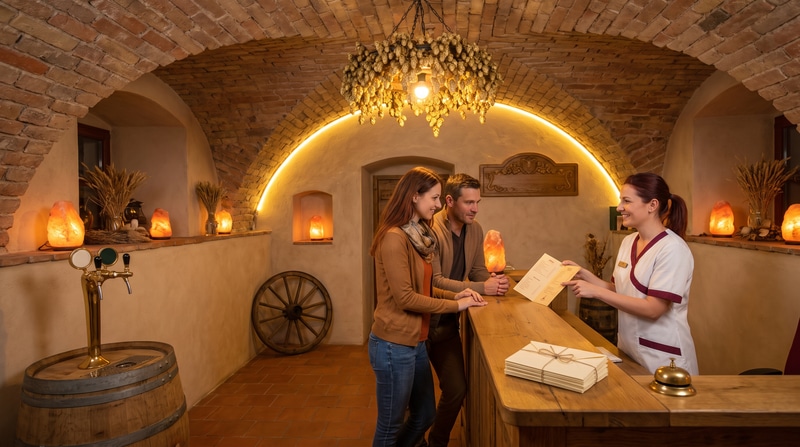
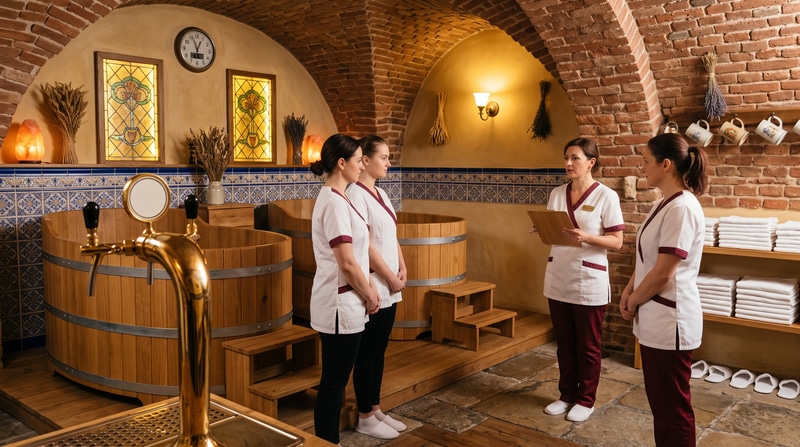
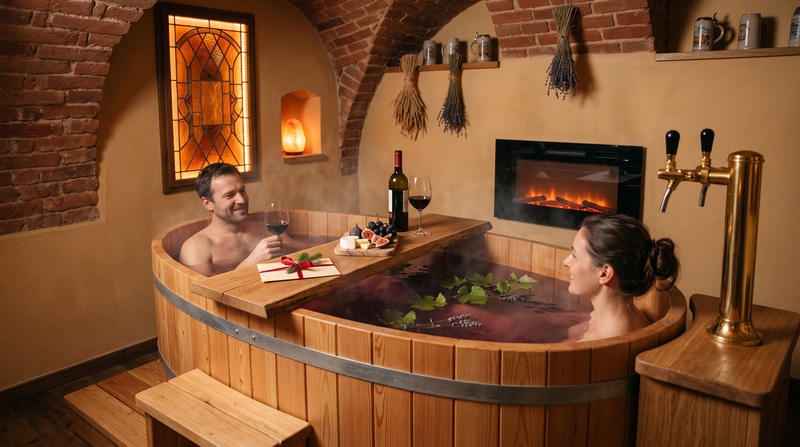
At Lázně Pramen, at Dejvická 255/18 in Prague 6, we have the ideal foundation for this flexibility: four separate private rooms, each with its own character. Golden Spring (Zlatý pramen), with two tubs, comfortably takes two to four guests and suits small groups and families; Ruby Spring (Rubínový pramen) offers an intimate bath for a couple; Emerald Spring (Smaragdový pramen), in a V.I.P. configuration, targets the most demanding guests; and Sapphire Spring (Safírový pramen), a salt cave, serves massages. This structure lets the same space be presented differently each time, depending on who we want to reach and when.
So how should you layer the product offer across the seasons?
- in winter and around the holidays, frame the beer bath as a warming ritual and a gift experience
- in spring and summer, lead with regeneration, detox and a calmer, off-peak pace
- for couples, build on the privacy of Ruby Spring and Emerald Spring
- for companies and groups, offer the capacity of Golden Spring and massage combinations
- all year round, pair a bath in genuine Czech craft Petrovická beer with a classic or combined massage
The key is that every season carries its own narrative frame. A guest hunting for a Christmas present in November hears a different story from a couple planning a romantic June evening. The product stays the same - a warm bath at 35 to 38 degrees Celsius in oak and larch tubs, made from Saaz hops, malt and yeast - but its presentation adapts. That creates the sense that something is always happening at the spa, which drives repeat visits across the whole year.
Gift vouchers as a tool for smoothing the season
Gift vouchers are one of the most powerful weapons a spa has against seasonality - and one of the most consistently underused. Their magic lies in the timing gap: revenue lands at the moment of sale, while the cost of delivering the service arrives later, often in an entirely different period. Managed shrewdly, voucher sales effectively pour revenue from the peaks into the quieter months.
Voucher sales naturally peak before Christmas, around Valentine's Day, and during graduation and anniversary season. That is good news for cash flow in those windows. The problem arises when guests then try to redeem all those vouchers during the same peaks, when capacity is already full. The operator's job is therefore to actively steer redemption into the weaker months - gently, but deliberately.
- set a generous validity period so guests are not rushed into the busiest dates
- during troughs, reach out to holders of unredeemed vouchers with available slots
- offer a small bonus for off-peak redemption - for example a longer session in the Sapphire Spring salt cave
- track the sold-versus-redeemed voucher ratio as a metric in its own right
- communicate that quieter dates mean a more private, undisturbed experience
The rising appetite for wellness and spa visits, confirmed by global data on the sector's expansion, plays straight into vouchers' favour - an experience as a gift is an increasingly default choice. For operators that means demand for vouchers exists year round, not just before the holidays, provided you actively pursue it. Anniversaries, birthdays and thank-yous happen in every month of the year.
For franchisees, managing vouchers is also a tool that sharpens the picture of return on investment considerably. Pre-paid voucher revenue cushions the risk of weak months and makes the financial plan more predictable. You will find more on the economics of running a spa and the terms of partnership on the page covering our franchise model.
Corporate clients and group bookings as a stabiliser
Where individual guests respond to the calendar with emotion and the turn of the seasons, corporate clients run on a different logic. Budgets, team-building, staff rewards and client hospitality are planned on a rolling basis, and often precisely outside the usual consumer peaks. That is exactly what makes the B2B segment the ideal counterweight to the seasonal swings of retail demand.
Corporate events also carry several traits an operator loves: they book well in advance, fill an entire room at once, and often recur. An employee-benefit scheme in the form of a spa voucher, a small reward for a sales team, or an informal company gathering in the privacy of the spa - all of it generates steady revenue in periods when the tubs would otherwise sit empty. Golden Spring, with its two tubs, is a natural choice for smaller groups, while a bath-and-massage combination turns the visit into a full afternoon programme.
- approach companies with the spa as a staff benefit, including outside the holidays
- build packages for small teams using the capacity of Golden Spring
- offer corporate gift vouchers in larger volumes
- cultivate lasting relationships with HR departments and executive assistants
- schedule corporate bookings deliberately into the weaker weeks
Developing corporate business demands systematic sales work - it is not a channel that switches itself on. It pays to invest the time in building contacts and in a clear offer that can be emailed over quickly. Anyone interested in a specific form of corporate partnership or a larger group booking can reach us through our contact page.
For investors and franchisees, the B2B segment is central to the stability of the whole model. Spreading revenue across individual and corporate clients reduces dependence on seasonal swings and makes the operation more resilient. A wider view of the commercial opportunity and the returns on offer is set out on the page for investors.
Year-round marketing instead of peak-only campaigns
A familiar paradox of spa marketing goes like this: the biggest advertising budget gets spent before Christmas, when demand is already at its highest, while in the lean months communication goes silent altogether. The result is that marketing deepens seasonality rather than smoothing it. The smarter approach turns the logic on its head - the heaviest marketing effort goes into the period that needs the jolt.
Year-round marketing calls for a content plan that respects the distinct character of each period and offers a relevant reason to visit in each one. This is not about endless discounts, which merely erode the perceived value of the experience. It is about working with story, setting and emotion. The quieter months can be sold as an advantage - as the time when a guest enjoys maximum privacy and the team's full attention.
- plan content and campaigns well ahead for the whole year, not just the quarter before the holidays
- in troughs, promote the benefits of an off-season visit: calm, privacy, flexible dates
- build an email database and work with reminders for former guests
- share stories and experiences on the blog and social channels continuously
- watch seasonal audience interest and tailor your themes to the time of year
Data on public interest in spa therapy show that search and audience attention respond to outside circumstances and the public mood - which means communication has to adapt rather than repeat the same message on a loop. In uncertain times people look for recovery and calm; in times of celebration they look for an experience and a gift. Good marketing reads those moods and adjusts both its tone and its offer.
Content marketing also carries a cumulative effect - articles, photographs and stories published today draw guests in months from now. That is precisely why it pays to build a blog and a steady presence as a long-term asset rather than a one-off campaign. Consistent visibility keeps the brand front of mind even when a guest is not yet searching for a specific date, but already associates the spa, half-consciously, with a feeling they will want to experience when their time comes.
Managing capacity, costs and team by the season
Marketing and product shape the demand side, but it is just as important to tune the cost and operations side to the season. Even if you managed to smooth demand perfectly - which never quite happens in practice - it still holds that in the strong months you want to extract the most from your capacity, and in the weak ones to avoid wasting resources. Discipline in cost management is often what decides whether a slow month closes in the black or the red.
The most significant variable costs in a spa are tied to heating the water and to staffing. Tubs held at 35 to 38 degrees Celsius consume energy regardless of how many guests turn up on a given day, so grouping bookings into blocks and concentrating them into fewer days of the week can save noticeably in the leaner periods. A flexible team deployment, too - a permanent core topped up with extra hands at the peaks - keeps payroll under control without compromising service quality.
- concentrate bookings into blocks so you are not heating a tub for a single guest
- schedule maintenance and shutdowns in the weakest weeks, not the peaks
- build a permanent core team supplemented by flexible support
- track energy consumption and service-delivery cost month by month
- give the team training and development precisely in the quieter periods
The slow months need not be pure loss - they can serve as time for maintenance, equipment renewal, staff training and preparation for the coming peak. A well-timed shutdown in a quiet week saves later losses in a period when every closed room would mean a booking that never happened.
For franchisees, this operational discipline is key to reaching the stated payback of eighteen to twenty-four months. Monthly operating costs for a spa run into the tens of thousands of euros, so the ability to manage them in step with seasonal demand directly shapes profitability. A detailed breakdown of operating economics forms part of the materials provided to franchise partners and to interested investors.
Seasonality as an opportunity, not just a threat
Seasonality cannot be abolished, but it can be turned from an unpredictable risk into a variable you control. Operators who genuinely know their year - who work with product variety, gift vouchers, corporate clients, year-round marketing and disciplined cost management - achieve far steadier revenue than those who passively wait to see what the calendar brings. The difference between the two is not a matter of luck but of the quality of planning.
Here are the most important steps that make up a year-round strategy resilient to demand swings:
- measure your own demand curve from real data spanning several years
- layer the product into seasonal frames without inventing new services
- steer both the sale and the redemption of gift vouchers deliberately into the weaker months
- build corporate clients as a counterweight to individual seasonality
- plan marketing across the whole year, with emphasis on the troughs rather than the peaks
- adapt capacity, costs and team deployment to the current season
Global data confirm that the spa and wellness sector is in sustained growth and drawing an ever wider clientele. That growth is an opportunity, but on its own it will not level out the seasonal swings of any particular operation - those remain a task for management. A growing market means the room for new guests exists all year; it comes down to whether you actively reach them outside the traditional peaks.
At Lázně Pramen we build year-round stability on a combination of a one-of-a-kind experience - a bath in genuine Czech beer in a historic cellar on Dejvická - and the deliberate management of demand across four private rooms. We hand the same principles to partners who open new sites with us. If you want to see what a resilient, predictable spa business could look like in your city, take a look at the terms of our franchise partnership, the options for investors, or simply get in touch.
Sources
- Global Wellness Institute - Spa Industry - globalwellnessinstitute.org
- Statista - Spa industry: statistics & facts - www.statista.com
- Public interest in spa therapy during the COVID-19 pandemic (PMC) - pmc.ncbi.nlm.nih.gov
- EHL Insights - Spa industry trends - insights.ehl.edu
- Zenoti - The ultimate guide to spa profitability and revenue - www.zenoti.com