Why price decides the fate of a spa concept
Price is never just a number on a menu. It is the loudest signal you send a customer before they have even crossed your threshold. In a spa business, where the guest is not paying for a measurable quantity of goods but for an experience, an atmosphere and a sense of being cared for, price becomes part of the product itself. Set it too low and you can, paradoxically, devalue the whole thing - the guest instinctively reads cheap as ordinary. Set it too high without the quality to match, and you scare off even the person who would happily have paid for something genuinely exceptional.
Since 2007, Lázně Pramen has been built on a simple premise: beer and wine baths are not a mass-market service but a distinctive experience for the guest who wants something an ordinary wellness centre cannot deliver. Hand-built 1,000-litre tubs in oak and larch, Žatec hops, a malt bath at 35-38 degrees C and four private rooms in a vaulted cellar in Prague's Dejvice district - none of these can be sold as a commodity. Price therefore does two jobs at once: it covers the real cost of running the business and it communicates the value on offer.
Industry analysts estimate the spa sector is growing by low single-digit percentages a year, and the number of venues competing not only on quality but on price keeps rising. Underestimate your pricing strategy and you lose margin at both ends - either you leave money on the table by charging less than the market would bear, or you drive guests away with an inflated menu you never bothered to justify. A well-built price does the opposite: it explains, it filters for the right audience, and it protects the profitability of the venue and of the wider franchise network. In the chapters that follow we set out how to approach pricing in this field systematically - from basic positioning to the more advanced models that deserve the attention of anyone weighing an entry into the sector.
Premium positioning as the starting point
The easiest mistake a new spa venue makes is trying to be the cheapest. In an industry built on experience, that strategy almost always fails. Premium positioning starts from the opposite end - from the value to the customer, from what the guest actually receives and how they feel while receiving it. Price then follows not from a cost calculation of hops and malt, but from the singularity of the whole experience and the setting in which it takes place.
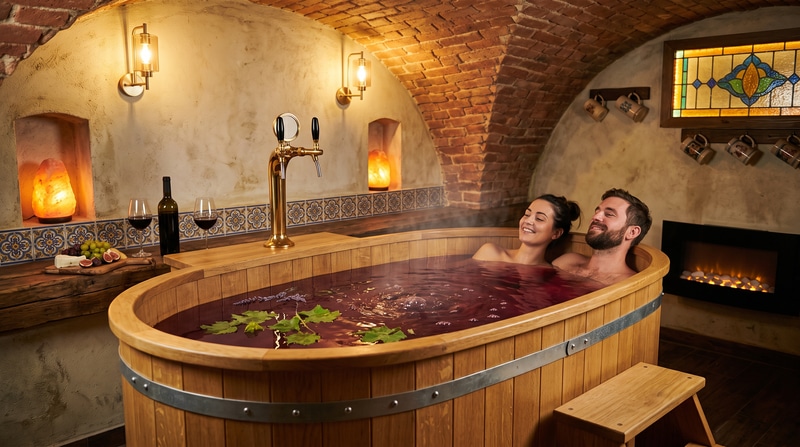
At Lázně Pramen, premium positioning is baked into the concept. The guest does not bathe in an anonymous pool but in a hand-built wooden tub inside a private room with a name of its own - Golden Spring (Zlatý pramen), Ruby Spring (Rubínový pramen), Emerald Spring (Smaragdový pramen) or Sapphire Spring (Safírový pramen). That setting carries a value cheap competitors cannot copy, and it is precisely why it justifies a higher price band. The pricing literature advises setting prices by perceived value rather than by cost; for a service where the experience is non-transferable, that advice counts double.
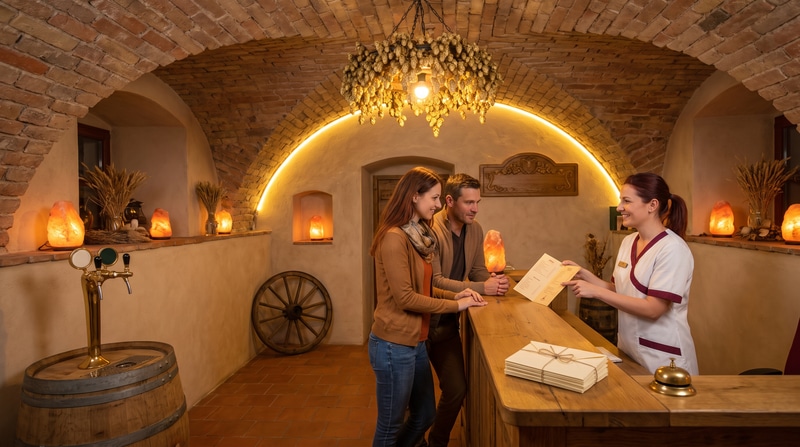
A premium strategy does, however, demand consistency. Every detail has to match the price: cleanliness, a bath at 35-38 degrees C, the quality of the Petrovické beer on tap, a frictionless booking process and the way the staff welcome each guest. A single stumble punctures the premium promise and leaves the guest feeling overcharged. The elements that hold premium positioning together are:
- privacy - no sharing the space with strangers
- authenticity of ingredients - Žatec hops, malt, yeast, Czech craft beer
- hand craftsmanship - tubs in oak and larch, not mass-produced plastic vats
- the calm, atmospheric setting of a vaulted cellar
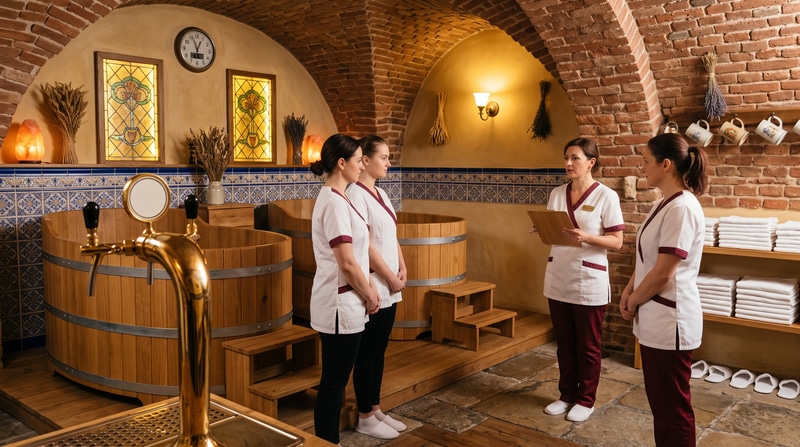
- personal service with no sense of being rushed
For anyone considering joining the franchise, grasping premium positioning is essential. It means the venue does not compete for customers on discounts but for the attention of a guest who is looking for something out of the ordinary. That position is more resilient to price wars and more sustainable over time. Prospective partners can learn more about how the concept works through a no-obligation consultation.
Dynamic pricing by demand and time
Where premium positioning sets the band your prices sit in, dynamic pricing governs how they move over time. The principle is straightforward: the price of a service shifts with real demand, the day of the week, the time of day or how far ahead the booking is made. The hotel industry has run on this logic for decades, and spas are adopting it steadily. Pricing sources in the wellness field report that a flexible pricing strategy can lift first-year revenue by anywhere from a few to the lower tens of percent, simply because it puts capacity to better use both at the peaks and in the troughs.
In day-to-day spa operations that means distinguishing between the hours when demand runs hot and the hours when rooms sit empty. Friday evening, Saturday and the run-up to public holidays sell themselves - here it makes sense to hold the full price. A midweek morning or the off-season, by contrast, is room to tempt a guest with a better offer without denting the premium positioning. The key is that any reduced price has a clear reason behind it (time, booking lead) and never leaves the impression that the service "normally" costs less.
The dynamic pricing tools that can be applied to a spa with a light touch include:
- peak pricing - a higher rate for the most sought-after weekend and evening slots
- early-booking incentives - a better price for the guest who reserves well in advance
- last-minute offers - filling open slots close to the date
- off-peak windows - weekday mornings and the low season
- multi-room packages - a different logic for a group booking of the whole space
It is precisely the variety of the four rooms at Lázně Pramen that lets this dynamic be used to real effect. Golden Spring, with its two tubs for two to four guests, suits couples and small groups alike, while the V.I.P. room Emerald Spring targets the guest who wants exclusivity and will pay a premium for it. Different formats mean different pricing logics under one roof. For investors, the dynamic approach is one of the levers for improving occupancy and moving toward the faster payback we turn to below.
Membership and subscription models: income you can count on
A one-off visit is wonderful, but unpredictable. A membership or subscription model turns the chance visitor into a regular and hands the venue something rare - repeat, plannable income. Wellness pricing analyses show that loyal guests account for a disproportionate share of total revenue: one industry study found that roughly two fifths of loyal customers generate around 80 percent of takings. And keeping an existing guest is far cheaper than winning a new one.
A membership model can take several forms in a spa setting. It need not be the unlimited-access card familiar from the gym. It is better understood as a set of well-considered formats that give the guest a reason to return and reward them for their loyalty. In the context of beer and wine baths - not a daily routine but an occasional treat - it makes sense to build membership as a club of benefits rather than a season ticket.
- prepaid credits - the guest pays for a larger bundle up front and draws it down over time at a better rate
- club benefits - priority booking on the busiest slots, a small extra touch
- a return programme - each further visit in the year at a preferential price
- gift vouchers - a form of prepaid income with deferred redemption, popular for both corporate and personal gifting
Gift vouchers are the natural bridge to prepaid-income logic at Lázně Pramen. The customer pays today, the guest redeems later - and the venue holds both the cash and the commitment of a future visit. The mix of baths, classic and combined massages and private rooms leaves further room to build offers that give the guest a reason to come back for a different experience from the one they tried first.
For the owner, predictable income is fundamental to planning costs and cash flow. That is exactly why membership and subscription logic features in the thinking of every investor and every candidate for the franchise - a stable stream of repeat income lowers the risk of the whole business and makes the payback calculation far easier.
Costs, margin and the floor of a healthy price
A premium price does not mean costs stop mattering. It simply means costs are no longer the starting point of pricing but its safeguard - the floor beneath which the price must not fall if the business is to make money. In the spa trade the cost structure differs from ordinary retail. A large part of it is fixed: rent on the space, the energy to heat the baths to 35-38 degrees C, staff wages, maintenance of the hand-built wooden tubs and cleaning. The variable cost of the raw materials themselves - hops, malt, yeast, the beer on tap - is comparatively small.
That structure has an important consequence: a venue's profitability stands or falls on occupancy. Every empty slot means the fixed costs keep running while the income does not arrive. This is why premium positioning and dynamic pricing complement each other - the first keeps the price band high, the second makes sure the capacity is not left idle. According to publicly available figures from the franchise model, the monthly operating cost of a single location runs between 15,000 and 25,000 EUR. That is a firm number, and the entire pricing logic has to be built around it so the venue not only covers its outlays but generates a profit.
When building the price list, then, a few rules are worth keeping to:
- know the true fixed cost per operating hour and never sell below that line
- calculate margin at the level of the whole venue, not a single service
- account for the differing cost profiles of the rooms - Sapphire Spring, a salt cave for massages, has a different economics from a room with a tub
- leave room for seasonal price movement without ever breaching the profitability floor
Since 2007, Lázně Pramen has held this balance. For anyone weighing an entry into the sector, the truth is that understanding the relationship between costs, occupancy and price is the foundation without which no amount of marketing will rescue a loss-making operation. The specific cost figures and projections can be walked through during a personal consultation.
The psychology of price: how the guest perceives it
Value is not an objective quantity. Two venues can offer a near-identical service at the same price, and the guest will still read one as good value and the other as overpriced. The difference lies in how the price is framed - in what precedes it, what surrounds it and how it is justified. Price psychology is therefore an integral part of pricing strategy, all the more so in an industry that sells an experience and a feeling.
The first principle is anchoring. If a guest sees the most expensive option first - say the V.I.P. room Emerald Spring - and only then the other rooms, those rooms read as more affordable than they would if the guest had started from the cheapest item. The second principle is the value frame: a price backed by concrete content (privacy, a hand-built tub, beer on tap, the calm of a vaulted cellar) goes down more easily than a bare figure. The guest is not buying an hour in a tub; they are buying an escape from an ordinary day, and that is a value worth naming out loud.
The third principle is consistency of signals. A premium price must be surrounded by premium signals - good photography, a clean booking process, clear communication. The moment a cheap element appears, the guest starts to question the price. The concrete tools that support price psychology are:
- present options from most expensive down to more affordable so anchoring works
- always explain what is included in the price and why it has value
- sell the experience and the feeling, not the minutes and litres
- maintain premium signals across the entire guest journey
- avoid heavy discounting that permanently undermines the price
At Lázně Pramen these principles work naturally, because the setting itself - the named rooms, the wooden tubs, the atmosphere of the cellar - proves the value of the price without a single extra word. For the operator, understanding how price is perceived matters as much as the calculation itself. Anyone who merely sets a price but cannot frame it loses the guests who would gladly have paid for value properly presented. There is more on the experience and its elements in the other articles on our blog.
Pricing strategy within the franchise model
The pricing of one venue is one thing. The pricing of a network expanding across Europe is a considerably tougher one. A franchise has to strike a balance between brand uniformity - so that a guest recognises Lázně Pramen anywhere by the same value promise - and local flexibility, because purchasing power and competition differ between Prague, another Czech city and a foreign capital. Premium positioning stays the common denominator, but the actual price band has to adapt to the local market.
This is exactly why the franchise model gives the franchisee a framework, not a straitjacket. The economics of the model are publicly known and provide firm boundaries within which pricing plays out. The entry fee is 50,000 EUR, the initial investment starts at 200,000 EUR and the total package exceeds 250,000 EUR. The franchisee pays a royalty of 6 percent of turnover and contributes 2 percent to a marketing fund, with the first three months exempt from royalties. Return on investment runs between 18 and 24 months, and roughly 6 months pass from signing the contract to opening. A location needs at least 150 square metres, and financing is typically available for 60-70 percent of the total sum.
These numbers show why pricing strategy is an existential question for the franchisee. A royalty calculated on turnover means that a higher but properly justified price benefits both the franchisee and the network. The fast 18-24 month payback is only achievable when the venue can combine premium positioning with dynamic use of capacity and the repeat income from prepaid vouchers. A price war or permanent discounting, by contrast, would break that framework and stretch the payback out.
For investors, pricing discipline is therefore one of the main factors that determine returns. A network in which every location understands its own pricing logic is more stable and more predictable than one in which individual venues undercut each other. Those interested in joining the network can walk through the whole model, financial projection included, via a no-obligation consultation.
Practical recommendations and summary
Pricing strategy in the spa business is not a one-off decision but a living system, tuned against results. The best approach combines every element we have covered: firm premium positioning as the base, dynamic pricing for smart use of capacity, membership and subscription models for stable repeat income, and price psychology to communicate value clearly. None of these works on its own - their strength lies in the sum.
Before you start setting prices, it is worth working through a few steps. They help you avoid the most common mistakes, where a venue either leaves money on the table or drives guests away with an unjustified price list:
- calculate the true fixed cost per operating hour and set the price floor
- define your premium positioning and make sure every detail of the experience matches it
- split slots into peak and off-peak and set dynamic prices with a clear rationale
- introduce prepaid and membership formats that reward returning
- frame the price list so anchoring and value explanation both do their work
- measure room occupancy regularly and fine-tune prices against real data
Publicly available industry estimates point to steady long-term growth in the spa sector and a rising number of venues competing for the guest. In that environment the winner is the operator who treats price not as a weakness to be hidden under discounts but as a tool for building value and protecting profitability. A premium concept built on authentic ingredients, hand craftsmanship and privacy is ideally suited to this strategy.
Lázně Pramen has applied this philosophy since 2007 at its Prague home in the Dejvice district, where four named rooms allow real pricing variety under one roof. For anyone contemplating an entry into the sector, a mastered pricing strategy is one of the pillars of success - and a well-designed franchise model carries that pillar over to new venues too. You can learn more about the specific economics, the payback projection and the opportunities for investors on our branch page or directly through the contact form.
Sources
- Dynamic Pricing for Spa Services: What It Is and Why to Use It - SpaSoft - www.spasoft.com
- Dynamic Pricing For Your Spa: The Key to Maximizing Its Revenue - Spa Voices - spavoices.com
- Spa pricing strategy: how to price services for profit - Zenoti - www.zenoti.com
- Spa Revenue Management: The Art of Pricing Optimization - Cayuga Hospitality - cayugahospitality.com
- Spa Industry - Global Wellness Institute - globalwellnessinstitute.org
- Pricing Strategies - ISPA / experienceispa.com - experienceispa.com