Why energy and water shape the economics of a beer spa
When an investor or operator models a spa built around bathing tubs, payroll and rent are usually the first lines on the sheet. Both matter. What sets this business apart, though, is physics: a large volume of water has to be heated and held at bathing temperature, the humidity it gives off has to be controlled, and the rooms need continuous ventilation. That makes a beer spa far more demanding on energy and water than a massage or beauty studio.
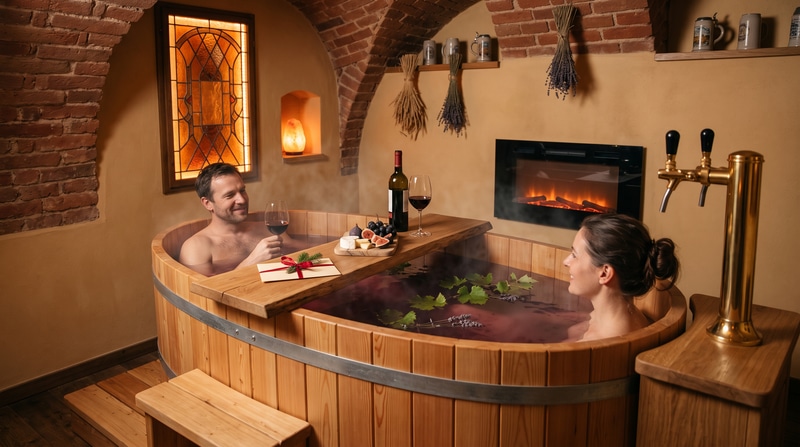
The Lázně Pramen concept is built on handcrafted oak and larch tubs that hold 1,000 litres of water at 35-38 °C. For the guest, each tub is the experience. For the plant room, it is a steady heat load through every opening hour. An operator who cannot say what makes up the energy bill has no way of influencing it.
This article is for readers who want to understand the cost side properly: owners of existing venues, prospective franchise partners and investors weighing up returns. The published monthly running cost of a single location is €15,000-25,000, and energy and water are already included in that figure. We do not publish the consumption or bills of any branch here. What follows is the mechanics: what sits behind each cost item, where business energy prices in Europe stand today, and which technical measures are actually in an operator's hands.
Heating 1,000-litre tubs and holding them at 35-38 °C
The largest energy item in a spa of this kind is the work done on the water itself. It helps to separate two loads: heating a fresh fill once, and holding the temperature while the tub is in use. The first is simple physics, and the sum is worth running as a reference point.
Raising one litre of water by 1 °C takes about 4.18 kilojoules, or roughly 0.00116 kWh. Say, purely for illustration, that we heat 1,000 litres from a cold supply at around 12 °C to a bathing temperature of 37 °C, a rise of 25 °C. The sum is 1,000 litres × 25 °C × 0.00116 kWh, which gives about 29 kWh of theoretical energy per fill, before heat losses or the efficiency of the source are counted. This illustrates the physics. It says nothing about consumption at any branch.
The second load, often underestimated, is holding the temperature. Water loses heat continuously through its surface, through the tub walls and through evaporation, so heat has to be topped up all the time. Wood insulates better than metal, which works in favour of oak and larch tubs, but losses remain, and they grow with the gap between water and room temperature. In practice:
- The higher the target within the 35-38 °C range, the higher the holding losses, and each degree adds up over a year.
- A cover while a filled tub is waiting for its guest cuts evaporation and radiant losses.
- Room temperature governs how fast the water cools: a cool cellar means more top-up heat.
- The efficiency of the heat source decides how much of the energy you buy ends up as warmth in the tub.
For an investor assessing return on investment, the takeaway is that heating is not a fixed cost. It moves with a string of operating decisions. A well-designed plant keeps holding losses down, while a poorly insulated venue pays for them every hour it is open.
Water and sewage: a cost you pay twice
Beyond the energy spent on heating, the water itself is a separate cost item, and in a spa it is anything but trivial. Every litre that goes into a tub is paid for twice: once as drinking water supplied and once as sewage taken away.
The cost model also has to allow for water used outside the tubs, in cleaning, hygiene routines, guest showers and other essentials, so tub volume alone does not set total consumption. It is also why the requirements for a new location under the franchise model include premises from 150 m² in a tourist zone or city centre with an accessible water and sewage connection. Without a reliable supply and drain, this business cannot operate.
A few principles are worth settling before anyone signs:
- Water and sewage prices vary by location and provider, so a tariff cannot be carried over from one city or country to another.
- The water bill grows with the number of tubs and the number of fills.
- Efficient fittings, showers and cleaning routines save water without touching the experience. The tub fill is a different matter: its replacement is set by hygiene rules and the operating regulations, so that is not where to look for savings.
- Local sewage tariffs can run higher than the water charge, so sewage deserves attention in its own right.
For the Dejvice branch and every new location alike, water is as much a raw material as Žatec hops, malt and yeast are in a beer bath. Every cut in unnecessary consumption goes straight to the operating result.
How much is at stake? The 29 kWh from the previous section allows a simple comparison for one 1,000-litre fill. This is an illustration, not the consumption or bill of any branch. No losses are counted, and energy is priced at the Eurostat EU averages for larger business consumers, covered in the section on business prices below; smaller users pay more. Water and sewage are priced at the 2026 Prague tariff published by Pražské vodovody a kanalizace (PVK), excluding VAT and converted at the Czech National Bank rate of CZK 24.36 to the euro.
- Heated directly by electricity: 29 kWh × €0.18 = about €5.20.
- Heated by gas: 29 kWh × €0.0616 = about €1.80, before boiler losses.
- Heated by a heat pump with a coefficient of performance of about 4 (about 7 kWh of electricity): about €1.30.
- Water and sewage for the same 1 m³: CZK 140.37 (water CZK 69.53, sewage CZK 70.84), or about €5.80.
Water and sewage for one fill therefore cost about as much as heating it directly with electricity, and at least three times as much as heating it by gas or a heat pump. Water is a cost item in its own right, which is why it deserves this much attention. Prague also shows the point about sewage in practice: at CZK 70.84 per m³ it costs slightly more than the water itself.
Ventilation and humidity: the hidden energy cost
The third energy cost, and the one most often overlooked, is air. Wherever large volumes of warm water are in use, evaporation is intense and humidity runs high. Without adequate, continuous ventilation the rooms would soon turn damp, the wooden tubs and structures would suffer and guests would be uncomfortable. Ventilation is an operating necessity, and it quietly eats energy.
It does so in two ways. The fans draw electricity throughout opening hours. The larger item, though, is that the system extracts warm, moist air and replaces it with fresh outdoor air, which has to be heated, especially in the colder half of the year. Unless it is recovered, heat you have already paid for goes straight out of the duct.
For the cost model, an investor should allow for the following:
- Ventilation demand rises in winter, when the gap between outdoor and indoor temperature is widest.
- Undersized ventilation saves energy in the short term but damages the building and lowers guest comfort over time, which makes it a false economy.
- Oversized ventilation without heat recovery pushes expensively heated air outdoors for no reason.
- Controlling ventilation to actual humidity, rather than running it flat out, can smooth consumption considerably.
Ventilation is where heat recovery pays off most, as the section on savings shows. The key point for an operator is that air handling is the third major part of the energy bill, not a side issue. The cellar spaces of Lázně Pramen have their own character, with a more stable temperature across the year but a greater need to remove moisture, so a well-designed air-handling system is part of every workable location.
Energy prices for businesses: what the 2026 data shows
A spa's running costs are sensitive to energy prices, which raises an obvious question for anyone building a model: which prices, and heading where? The relevant figures are the ones Eurostat publishes for non-household consumers, and in 2026 they are falling.
For electricity, the EU average for businesses using 500-2,000 MWh a year was €0.18 per kWh in the first half of 2026, down 5.4% on the first half of 2025 and 2.0% on the second half of 2025. The spread across the EU is wide: Ireland was highest at €0.2666 and Finland lowest at €0.0928, so the top price is nearly three times the bottom one.
For natural gas, the EU average for businesses using 10,000-100,000 GJ a year was €0.0616 per kWh in the same period. Year on year, prices fell in every reporting EU country except Sweden (+3.1%), which also had the highest price at €0.1118. Bulgaria had the lowest at €0.0438.
One caveat: both bands are far larger than a single spa, and a smaller business normally pays more per kWh. These figures show the direction and the differences between countries. They are not a tariff to put in a business plan. For that, get a real offer for the address.
For the operator and the investor, several conclusions follow:
- Business prices are falling after the jump of 2021-2022, so calculate the payback of an efficiency investment at today's prices, not on the assumption that prices will rise.
- Fixing a price buys predictability, but a long fix signed on a falling market can lock in a price above the market. Contract length is a decision, not a reflex.
- The choice of heat source decides which price risk the operation carries.
- The gap between countries is large, so the energy line depends on where the location is, and that matters to a network entering new countries.
The published €15,000-25,000 a month per location is the number that already contains energy and water, and the franchise model treats energy as a variable cost, not a fixed one.
Where to save: insulation, heat recovery and heat pumps
The good news for operators is that the energy bill is the result of a series of decisions, and several technical measures taken together can cut it sharply without taking anything away from the guest. The order below follows the logic of priorities: first stop losing heat, then produce it cheaply.
Start with insulation. The better insulated the tubs, hot-water pipes, storage tanks and the room itself, the less heat escapes and the less the source has to replace. The wooden tubs help, but pipes and tanks deserve the same attention. A cover on a filled tub waiting for its guest is the cheapest measure of all, and a highly effective one.
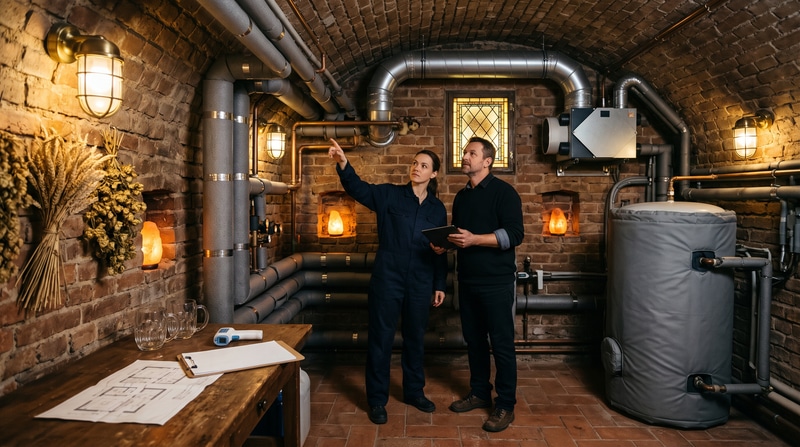
Next comes heat recovery. As the ventilation section showed, the air-handling system extracts expensively heated, moist air. A heat-recovery unit transfers heat from that air to the incoming fresh air and sharply reduces the energy needed to warm it. The same thinking applies to warm wastewater. In a business that goes through this much hot water, heat recovery is among the first investments worth costing out.
The third measure is an efficient heat source. The International Energy Agency (IEA) puts the coefficient of performance of a typical household heat pump at around four, meaning four units of heat for each unit of electricity, and rates current models as 3-5 times more efficient than gas boilers. These are household figures, so a commercial installation needs its own calculation, but they show why the choice changes both the cost of heating and the exposure to fuel prices. As a practical list:
- Insulate tubs, pipework and tanks, and cover filled tubs while they wait. The cheapest savings come first.
- Install heat recovery on the ventilation and consider recovering heat from wastewater.
- Choose an efficient heat source, such as a heat pump.
- Weigh up any fixed energy price: it buys predictability, but on a falling market a long contract can lock in a price above the market.
- Run ventilation and top-up heating to actual need, not flat out.
These measures do not compete, they add up. A venue that combines good insulation, heat recovery and an efficient heat source has a lower and more stable energy profile than one that relies on any of them alone.
Fitting energy into the wider operating model
Each of these measures makes most sense when judged against the whole operating model. Energy and water are significant, but they are only part of the published €15,000-25,000 a month per location, alongside rent, payroll for a team of four to six, raw materials and marketing.
The test is simple: weigh an efficiency investment against how long and how intensively the venue will run. The longer a location operates and the higher its occupancy, the faster money spent on insulation or heat recovery comes back, because the saving repeats every day. In a venue with low utilisation, payback can be slower. Energy decisions therefore cannot be separated from the occupancy plan and the marketing behind it.
For prospective franchise partners, the partnership includes help with site selection and two weeks of staff training, and roughly six months pass from signing the agreement to opening. That is the moment to get the energy design right, because retrofits always cost more than a sound initial project. The franchise terms are a fee of €50,000, an initial investment from €200,000, a total package from €250,000, a royalty of 6% of turnover plus 2% to a marketing fund, the first three months royalty-free and a payback of 18-24 months. Financing is typically available for 60-70% of the total.
For those still modelling the numbers:
- Deal with energy at the site-selection and design stage, not once the venue is open.
- Judge efficiency investments against the planned length of operation and occupancy.
- Set the length of energy contracts deliberately, with today's market prices in front of you.
- Track energy as a separate line so you can see what each measure achieves.
If you would like to go through the parameters for your own location, get in touch via our contact page and arrange a no-obligation consultation.
In closing: energy is a cost you can manage
A beer spa runs on hot water, so energy and water are among its defining costs. Operators who grasp this can estimate running costs realistically and have concrete ways of influencing them. Those who underestimate it pay for that every hour they are open.
We have covered the three main cost drivers: heating and holding 1,000-litre tubs at 35-38 °C, water use with its supply and sewage charges, and the energy-hungry ventilation that keeps humidity in check. Each can be managed, from insulation and tub covers, through heat recovery from extract air and wastewater, to efficient sources such as heat pumps and a considered energy contract. The measures add up, and they are best designed in at the project stage.
The European picture sets the frame. Business energy prices are now falling, but the differences between countries remain large, so efficiency has to stand on its own at today's prices and cannot rely on future price rises. An investment that passes that test pays back faster the longer and more intensively a location runs, which is why it belongs in the thinking of anyone weighing an investment in this sector.
The Lázně Pramen concept, with its handcrafted oak and larch tubs, shows that a premium experience and rational energy management can go together when the plant is designed with care. If you are weighing a location of your own or want to work through the cost model in detail, study the terms of the franchise, read more on our blog and reach out via our contact page.
Sources
- Eurostat - Electricity price statistics - ec.europa.eu
- Eurostat - Natural gas price statistics - ec.europa.eu
- IEA - The Future of Heat Pumps: How a heat pump works - www.iea.org
- Pražské vodovody a kanalizace - Cena vodného a stočného - www.pvk.cz