Why small spas need their own set of metrics
A hotel wellness floor is measured in ways that make little sense for a small spa built around private rooms. If you run, own or, as a passive investor, simply watch an operation with a handful of rooms, the standard hotel dashboard is more likely to mislead you than to help. You need metrics tied to the real capacity of the building and to the way it is sold: not single treatments in an open hall, but a whole private room for a fixed block of time. That difference decides which numbers support a decision and which are just charts.
Take our unit in Prague-Dejvice as a working example. It has four private rooms, and together they set a hard ceiling on what can be sold: Golden Spring (Zlatý pramen) with two tubs for two to four guests, Ruby Spring (Rubínový pramen) with one tub, Emerald Spring (Smaragdový pramen), a V.I.P. room with one tub, and Sapphire Spring (Safírový pramen), a salt cave with a massage table and no tub. Each room is booked privately and as a whole, so the two tubs in Golden Spring never go to two separate parties. Write that capacity down once and you have the denominator for almost every metric that follows.
This article is about formulas, not figures. We do not publish our own numbers, and we do not present anyone else's benchmarks as the norm: spa benchmarks vary so widely by region, format and price point that a borrowed figure invites the wrong conclusion. Instead, each metric below comes with how to calculate it from your own booking system and what decision it points to, with the Lázně Pramen format as the running example. A good KPI is not the one that looks tidy in a deck but the one that tells you what to do next: open another time slot, restaff a shift or reprice a slow weekday.
RevPATH: revenue per available treatment hour
The most important revenue metric for a small spa is RevPATH, revenue per available treatment hour. It is the spa counterpart of a hotel's RevPAR and shows how well you turn the time available in your rooms into money. Xotels, in its overview of spa revenue management KPIs, defines it as treatment revenue divided by the number of treatment rooms multiplied by opening hours. The result is what each available room-hour earned on average, whether it was sold or not.
Both halves of the fraction need care. The numerator is revenue from procedures only: room bookings and massages. Gift voucher sales and add-ons are tracked as separate lines; otherwise RevPATH mixes the use of capacity with cash that has nothing to do with it. The denominator is capacity units times opening hours, not the opening hours of the building alone. In the Lázně Pramen format the capacity unit is the room, because each room is sold as a whole: the four rooms in Dejvice are four units, Golden Spring included, despite its two tubs. Assume, purely for the arithmetic and not as our actual schedule, ten opening hours a day. Four rooms times ten hours gives 40 available room-hours a day, and that is the figure you divide by.
RevPATH is useful because it folds two levers into one number. A room sold at a discount and a room sold at list price both end up in it, so you can see whether performance is driven by volume or by price. Track it over time and split it by day of the week and time of day. A dip on a weekday morning calls for one response, such as a time-limited offer on the weak slot; a dip at the weekend raises different questions, about shift cover and block length. And read the trend rather than a single month: any one period moves with the season, and there is rarely a reason to react in haste.
Room utilisation: how much capacity you actually sell
Where RevPATH measures money, utilisation measures time: what share of the available capacity did you actually sell? The Global Wellness Summit's Spa Profitability Handbook uses treatment-room utilisation as a basic gauge of how well a spa fills its capacity. The formula is room-hours sold divided by room-hours available, times 100. With the illustrative 40 available room-hours a day, selling 24 of them gives you 60% utilisation.
Count hours, not bookings, because blocks differ in length. A beer or wine bath takes a 1.5-hour block (20 minutes in the tub, then rest), a V.I.P. package 2.5 hours and a massage in the salt cave 30 to 90 minutes. Ten bookings can fill a room for a whole afternoon or for barely half of it; only hours show how much of the room was really used.
Utilisation is the diagnostic twin of RevPATH. If RevPATH is low while utilisation is high, the problem is price: you sell plenty, but cheaply. If both are low, the problem is demand or the time slots on offer, and the rooms sit empty. The cuts worth watching:
- utilisation by day of the week, to find the weak days worth a targeted offer;
- utilisation by time of day, which exposes dead morning slots;
- utilisation per room, since a V.I.P. room, a standard room and the salt cave with its shorter blocks behave very differently;
- guests per booking in Golden Spring against its capacity of two to four: it shows whether the room's capacity is actually used, and it changes the cost per booking, since drinks and snacks are included in the price and a party of four consumes more than a party of two.
Each cut leads to a concrete move: reshuffling the blocks on offer, shifting staff to the peak or steering a larger group into the larger room. How the individual rooms are laid out is shown on the rooms page of our Dejvice unit.
Average spend per visit and what it is made of
Average spend per visit completes the core trio from the other side: how much one booking, or one guest, actually brings in. The formula is revenue from procedures and add-ons divided by the number of visits in the period. Decide up front whether you count per booking or per guest. With private rooms, where a couple or a group arrives for one block, it pays to track both, because they point to different decisions.
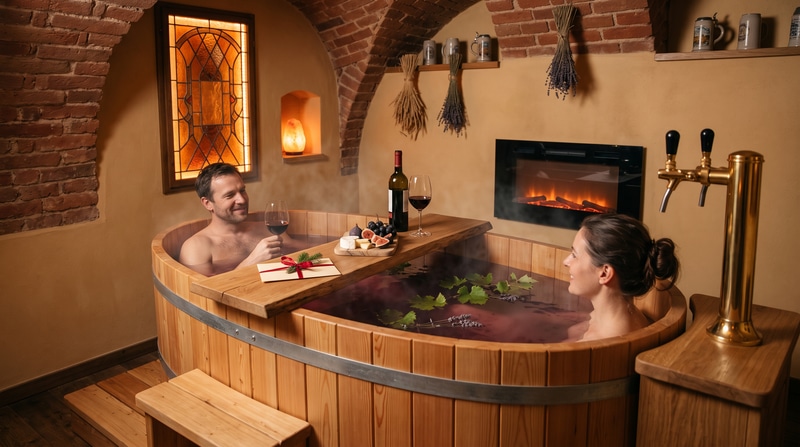
The average on its own tells you little; the breakdown shows where there is room to grow. In the Lázně Pramen format spend has a few clear components. First, the bath itself, beer or wine, with drinks included in the price: a beer bath comes with unlimited light or dark beer and snacks, a wine bath with a bottle of wine and a plate of fruit and cheese. Second, a massage in the Sapphire Spring salt cave (a relaxation massage, instrument lymphatic drainage or a mud and peat application), added before the bath or booked on its own (the lymphatic drainage only on its own). Third, any other add-ons. There is no separate drinks line on the revenue side. Drinks and snacks belong on the cost side, as consumption per booking that the package price has to cover.
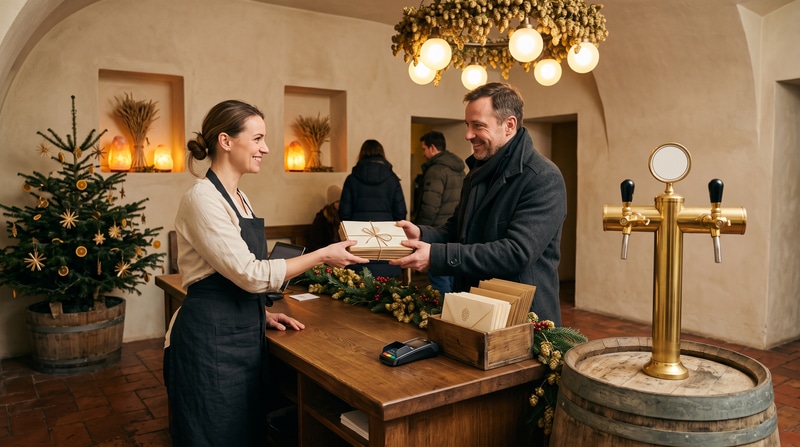
Gift vouchers need handling of their own. A voucher sold is not yet revenue: it is a prepayment that becomes revenue when the voucher is redeemed, or when it expires unused. So there is no such thing as a "share of revenue from vouchers". Track voucher sales (cash in) and redemptions as two separate lines; only redemptions show up in utilisation and RevPATH. We cover the accounting side in our article on the economics of gift vouchers.
Broken down this way, the levers become visible. A low massage share, for example, suggests offering the bath-and-massage combination at the booking stage rather than on arrival. Watch:
- average spend per booking by room type;
- the share of bookings that include a massage;
- add-ons per booking;
- drinks and snacks consumed per booking, as a cost to hold against the package price.
One trap: average spend must not grow at the expense of utilisation. Pushing longer blocks hard can lift spend per booking while cutting the number of filled slots. Read average spend together with RevPATH and utilisation, never on its own.
Repeat rate and no-shows: the health of demand
The first three metrics describe what happened to capacity and money. The next two describe the health of demand: do guests come back, and do they turn up at all? Repeat rate is repeat visits in the period divided by all visits, times 100; alternatively, the share of customers who came more than once. A regular guest is the cheapest growth there is, since winning one back costs far less than attracting someone new.
For a private-room spa, though, the repeat rate needs careful reading. Many visits are gifts or one-off occasions, so a low figure need not point to a quality problem; it may simply reflect the product. Track repeat visits separately for guests who booked for themselves and for those who came on a gift voucher, for whom a return visit is a bonus. It is also worth watching how many voucher recipients later come back and pay for themselves.
The no-show rate, the share of bookings that neither took place nor were cancelled in time, hits revenue directly. The formula is no-shows divided by confirmed bookings, times 100. Every no-show is an empty room that can no longer be filled, because blocks are long and booked in advance. Keep no-shows apart from timely cancellations, which can still be resold; they call for different responses. A high no-show rate calls for concrete steps:
- a reminder before the appointment by email or text message;
- a confirmation step when booking the more expensive blocks;
- clear cancellation terms and, for large groups, a possible deposit;
- a waiting list for peak slots, so a freed-up block fills quickly.
Read both metrics as trends. Any single week fluctuates, but a steady rise in no-shows or a slide in repeat visits is an early warning that something in the guest journey is not working.
Labour cost share and shift productivity
Revenue is only half the picture. In a small spa the largest controllable cost is almost always labour, which is why labour cost share belongs in every monthly report: labour cost for the period divided by revenue for the same period, times 100. It tells you how much of every euro earned goes to the attendants, the massage therapists and the reception shift.
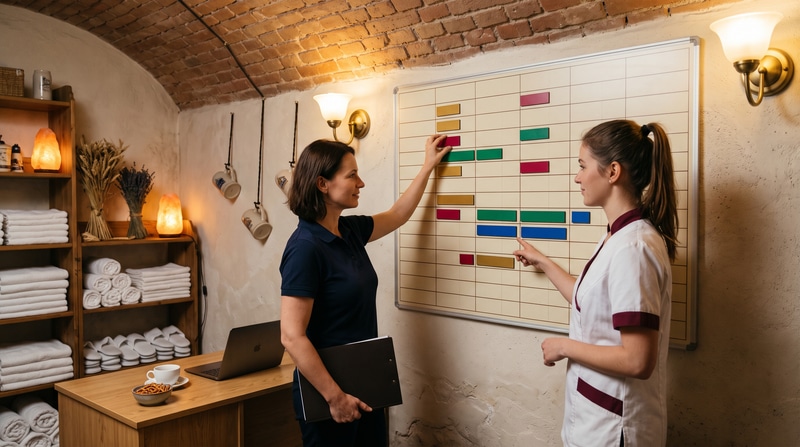
Read it alongside utilisation, because labour is tied to the shift rather than to the booking. A unit in our format runs with four to six staff, and once a shift starts the cost is there whether the rooms are full or empty. Labour cost share therefore improves mainly by matching staffing to demand: covering the peaks and trimming the dead slots instead of keeping the same headcount all day.
A useful companion is productivity: revenue per hour worked, or bookings handled per shift. When productivity rises and labour cost share falls, the shifts are well planned. When the same morning slot drags both down, you know where to look. Track:
- labour cost share by day of the week and by shift;
- revenue per staff hour worked;
- bookings handled per shift;
- the share of variable pay tied to selling massages and add-ons.
For anyone considering running the brand as a franchise: our model includes two weeks of staff training and assumes monthly running costs of roughly EUR 15,000-25,000, depending on the size of the unit. That is the frame labour cost share sits in, and the reason it belongs in the report an investor reads as well.
Online ratings as an operating metric, not just marketing
Online ratings usually get filed under marketing, but for a small spa they are an operating metric in their own right. The average score on review platforms and maps decides how many new guests consider booking at all, and for an occasional purchase, often bought as a gift, strangers' reviews carry more weight than they would for an everyday service. That is why ratings belong in the monthly report next to revenue and costs.
Watch three things, not just the average. First, how the score moves over time: an old bad month weighs differently from a recent dip. Second, the number of new reviews in the period: with a thin flow, a couple of negative reviews can move the average more than they should. Third, your response rate, meaning how quickly and how often you reply. A reply to criticism is not a defence but operational feedback that future guests can read.
Link ratings to the other metrics. When repeat visits are slipping and reviews keep returning to the same point, whether waiting time, water temperature or service, you have a concrete operational fix instead of a vague impression. The brand's 1,000-litre tubs, handmade from oak and larch, are kept at 35-38 °C; holding that steady is exactly what reviews pick up on, so it needs managing every day, not in bursts. A practical routine:
- record the average score and the number of new reviews once a month;
- sort recurring praise and complaints by theme;
- assign each recurring theme a concrete operational step;
- check whether the theme fades from later reviews after the fix.
Other operational topics are covered on our blog.
Building a report that actually drives decisions
Individual metrics are useful, but the value comes from putting them into one monthly view and drawing actions from it. A good report for a small spa fits on one page and follows a clear logic: from money, through capacity, to demand and costs. RevPATH and utilisation at the top; average spend and its breakdown in the middle, with voucher sales and redemptions alongside; then repeat rate, no-shows and labour cost share, with online ratings as context.
Every metric should show three things: the current period, the previous period and the trend. Without the trend, a single number invites an overreaction to normal seasonal swings. Below the figures, leave space for two or three sentences that turn them into a concrete step for next month: open a time slot, reshuffle shifts, run an offer on a weak day, tighten reminders against no-shows. A report without a decision is just an archive.
The metrics work as a set. RevPATH tells you whether there is a problem; utilisation and average spend show which side it is on, volume or price; repeat rate, no-shows and labour cost share show whether the cause lies in demand or in how the operation is run. Only together do they form a picture rather than a puzzle. The same logic holds for a single unit and for a franchise network comparing several units.
For operators considering expansion through a franchise, these metrics are the shared language between head office and the unit; for investors, they are a way to judge the health of an operation without being there every day. Our model allows about six months from signing to opening, and the first three months are royalty-free, so the first reports mainly serve to fine-tune the operation. If you want to go through these metrics for your own case, get in touch via our contact page and we will arrange a consultation.
Sources
- Xotels - KPI for Spa Revenue Management: SUR, ATR, REVPATH, SREVPOR - www.xotels.com
- Global Wellness Summit - Spa Profitability Handbook (treatment room utilisation) - www.globalwellnesssummit.com